
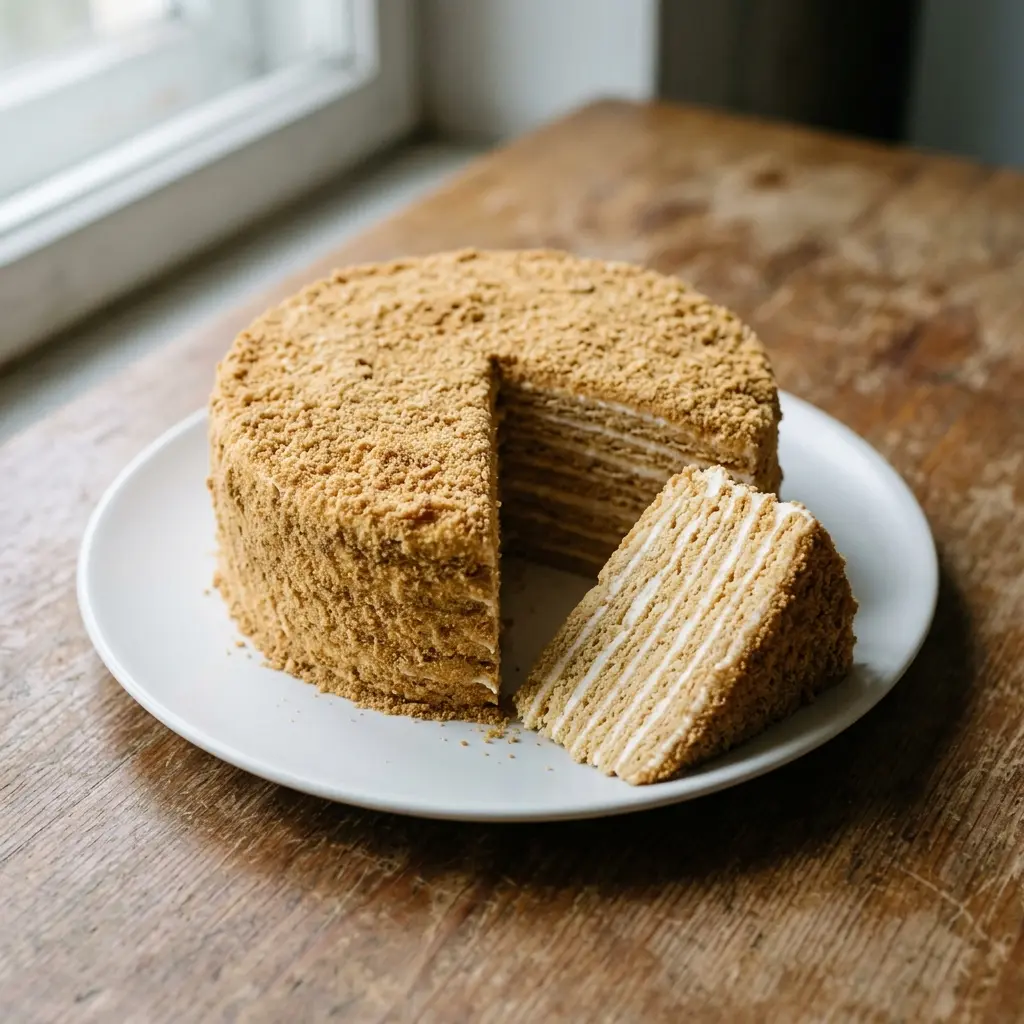
Medovik is a layered honey cake: eight or more very thin honey sponge layers stacked with a tangy sour cream frosting and coated in crumbs made from the baked trimmings.
Medovikмедовикsay meh-doh-VYKalso honey cake, Russian honey cake, medovyk, medivnyk
The layers come out of the oven crisp, almost like large honey biscuits. The magic happens in the fridge: overnight, the cream soaks into them until the whole cake turns soft, moist and easy to cut, with a taste of caramelised honey and a light sourness from the smetana-style cream.
It is one of the best-loved celebration cakes in Ukraine and across the former Soviet Union, the cake that appears at birthdays, name days and New Year tables. In Canada you will find it in Ukrainian, Polish and Russian delis and bakeries, often sold as "honey cake" or "Russian honey cake".
This guide covers what medovik is made of, what is documented about its history and what is legend, how it differs from its honey-cake cousins across Europe, and a full home recipe with metric and imperial measures.
Medovik in short
- Medovik is a cake of 8 to 10 thin honey layers with sour cream frosting and a crumb coat.
- The layers bake crisp and soften overnight as they absorb the cream.
- The popular story of a chef who won over Empress Elizabeth Alexeyevna around 1820 is a legend with no historical record.
- The earliest known Soviet printed recipe appears in a Ukrainian-language cookbook published in Kyiv, "Ukrainian Dishes" (1957, reissued 1960).
- Honey doughs called medivnyk were already in Galician Ukrainian cookbooks before the Second World War.
- A medovik keeps 4 to 5 days in the fridge and freezes well.
Where does medovik come from?
Honey is the oldest sweetener in Eastern European baking, and for centuries it went mostly into spiced honey breads and gingerbread-style doughs. In Ukrainian those honey breads and cakes are called medivnyky, and the tradition is shared with Poland (miodownik), the Czech lands (medovník), Lithuania (medutis) and Russia (prianiki). The layered medovik with cream belongs to this family, and as a cake of thin sponge layers it is a much younger dish.
The written record for medovik as we know it starts in the 20th century. Ukrainian food writers have traced honey doughs called medivnyk through Galician cookbooks published before the Second World War, among them a 1938 household book from Kolomyia with a section on medivnyk that includes versions layered with cream.
In Soviet print the trail begins in Kyiv. Culinary historians Pavel and Olga Syutkin found the first Soviet recipe for medovik in the Ukrainian-language cookbook "Ukrainian Dishes" ("Ukrainski stravy"), published in Kyiv; the Ukrainian Wikipedia article and the Lviv food historian Marianna Dushar date the first edition to 1957, and the Syutkins cite the 1960 edition. The Ukrainian cookery writer Daria Tsvek later published dozens of variations.
Is the story about Empress Elizabeth Alexeyevna true?
The story you will read on most bakery websites goes like this: around 1820, a new young chef in the kitchen of Emperor Alexander I baked a honey cake for Empress Elizabeth Alexeyevna. She was said to dislike honey, yet she loved the cake, rewarded the chef, and medovik became the fashion among the nobility.
It is a legend. No memoir, court record or cookbook of the period mentions such a cake. The Syutkins, writing in The Moscow Times, list the problems: the imperial table was tightly controlled, with the court physician overseeing the family's food, so an unknown cook serving the empress an untried dish is hard to imagine; and Russian cookbooks of the time, such as Vasily Levshin's dictionary of the 1790s and Navrotsky's book of 1808, contain no honey cakes of this kind. The only honey dough in those books is for gingerbread.
The same tale of a new chef and a royal who changes her mind is told about other cakes in other countries, which is another sign of a story that travels from dessert to dessert. It is a charming legend, and it is best enjoyed as one.
How did medovik become so popular?
Medovik spread as a home cake. Everything in it was available in an ordinary kitchen: honey, eggs, flour, butter, sour cream. It needed no special pans, since the layers are rolled out and cut around a plate, and it could be made a day ahead, which suited family celebrations.
The Syutkins note that in Soviet times medovik stayed a home cake, absent from cafeteria and restaurant menus, and families learned it from each other, which is one reason so many versions exist today: some swear by sour cream, others by boiled condensed milk, others by custard.
Emigrants from the region took the cake with them, and today medovik is a fixture of Eastern European delis and bakeries in Canada, the United States, Israel and Western Europe, as well as a favourite of home bakers who like a cake they can make the day before.
Is medovik Ukrainian or Russian?
The honest answer is that medovik belongs to a shared tradition. The word exists in Ukrainian, Russian and Belarusian, all from the Slavic word for honey. The romantic origin story set in St Petersburg has no evidence behind it. The documented record points to Ukrainian kitchens: honey cakes in Galician cookbooks and the first Soviet printed recipe in a Kyiv cookbook.
What can be said with confidence is that the modern layered medovik took shape in 20th-century home kitchens of the region, and that Ukrainians have every reason to count it among their own cakes.
What kinds of medovik are there?
- Sour cream medovik (the classic)
- Thin honey layers with a frosting of sour cream, sugar and sometimes whipped cream. It is the lightest and tangiest version and the one most Ukrainian families make. In Canada, grocery sour cream at 14% is thinner than Ukrainian smetana at 20–25%, so bakers here often fold in whipped 35% cream or drain the sour cream through cheesecloth for a few hours.
- Boiled condensed milk and butter
- A richer frosting of dulce de leche, made by boiling a can of sweetened condensed milk, beaten with soft butter. The Syutkins give this version as their family recipe. It is sweeter and more caramel-like, and the cake holds its shape better at room temperature.
- Custard medovik
- The layers are spread with a cooked custard of milk, eggs, sugar and flour, often finished with butter. It gives a softer, pudding-like crumb and suits people who find sour cream too sharp.
- Medivnyk
- A Ukrainian name for honey cakes, and in its narrow sense a honey cake baked without layers of cream. Many families, especially in Western Ukraine, use the word for the layered cake too.
- Frying-pan medovik
- A home shortcut: the rolled rounds of honey dough are baked one by one in a dry, heavy frying pan on the stovetop for a minute or two on each side. Handy when the oven is small or busy, with layers a little less even.
- Czech medovník and Marlenka
- The Czech medovník is a close cousin, often finished with a caramel cream and walnuts. Marlenka, the honey cake brand founded in 2003 in Frýdek-Místek, Czech Republic, by the Armenian-born Gevorg Avetisyan from a family recipe, follows the same idea of thin honey layers and cream.
The recipe
Classic medovik with sour cream frosting
Eight thin honey layers cooked over a water bath, rolled out and baked, then stacked with sour cream and whipped cream frosting and rested overnight.
Ingredients
Honey layers
- 100 g (7 Tbsp) unsalted butter
- 100 g (⅓ cup) runny honey
- 200 g (1 cup) granulated sugar
- 3 large eggs, at room temperature
- 1½ tsp baking soda
- About 450 g (3½ cups) all-purpose flour, plus a little for rolling
Sour cream frosting
- 750 g (3 cups) full-fat sour cream, well chilled
- 250 ml (1 cup) whipping cream, 35%, well chilled
- 120 g (1 cup) icing sugar
- 1 tsp vanilla extract
Method
- 1
Melt the honey base
Set a heatproof bowl over a pot of barely simmering water. Add the butter, honey and sugar and stir for 3 to 4 minutes, until the butter melts and the sugar mostly dissolves.
- 2
Add the eggs
Beat the eggs in a separate bowl. Whisk a spoonful of the warm honey mixture into them, then pour the eggs into the bowl over the water, whisking all the time so they do not scramble.
- 3
Add the baking soda
Whisk in the baking soda and keep whisking over the heat for 2 to 3 minutes. The mixture will foam, rise and turn a light caramel colour.
- 4
Mix the dough
Take the bowl off the heat and stir in the flour a cupful at a time until you have a soft, slightly sticky dough that pulls away from the bowl. It firms up as it cools.
- 5
Divide the dough
Heat the oven to 180°C (350°F). Divide the warm dough into 8 equal pieces, about 110 g each, and keep them covered with a bowl so they stay soft.
- 6
Roll a layer
On a sheet of baking paper dusted with flour, roll one piece into a round a little larger than 22 cm (9 in) and 2 to 3 mm thick. Prick it all over with a fork.
- 7
Bake and trim
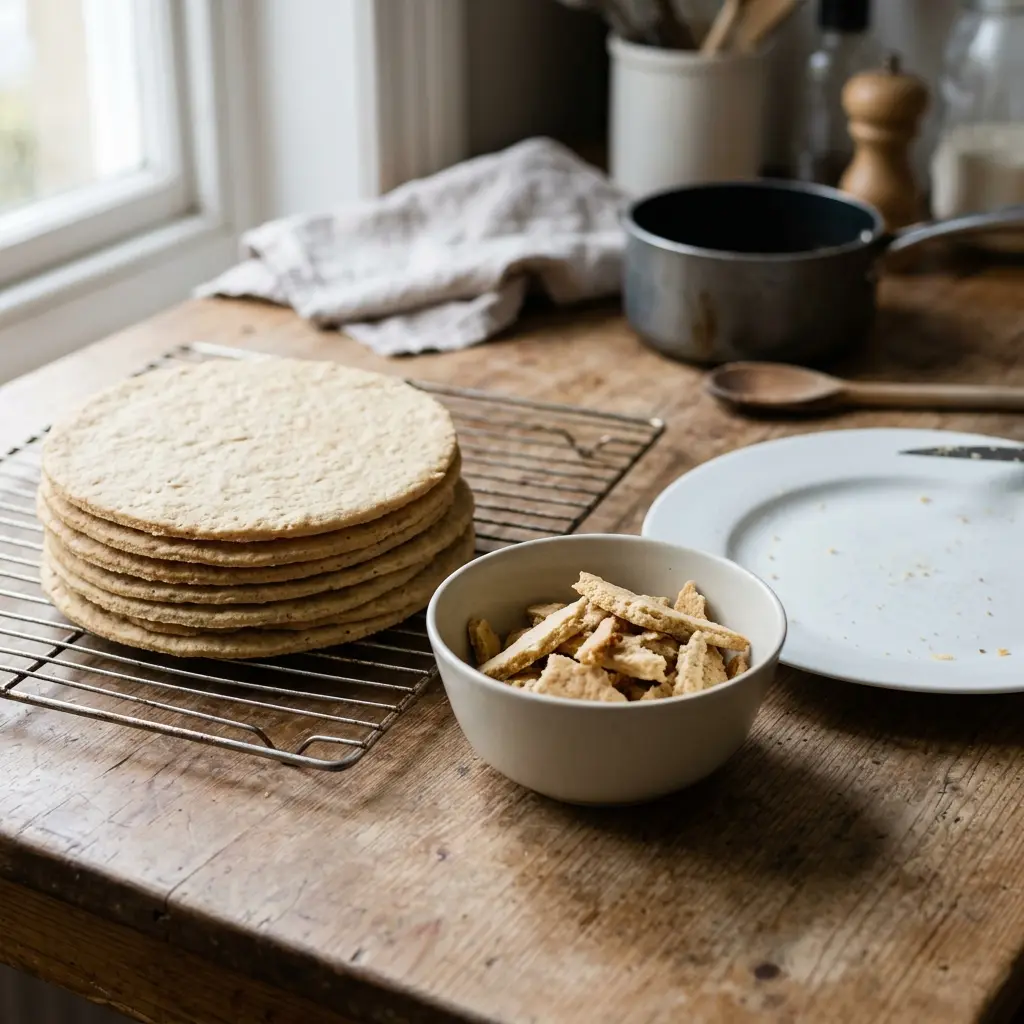
Slide the paper onto a baking sheet and bake for 5 to 6 minutes, until evenly golden. While the layer is still hot, cut around a 22 cm plate or cake ring and keep the trimmings. Repeat with the remaining dough.
- 8
Make the crumbs
Spread the trimmings on a baking sheet and bake for 3 to 4 minutes more, until a shade darker. Cool, then crush to fine crumbs in a bag with a rolling pin or in a food processor.
- 9
Make the frosting
Whip the cold whipping cream with the icing sugar and vanilla to soft peaks. Fold in the cold sour cream in two additions, gently, until smooth.
- 10
Stack the cake
Place one layer on a serving plate and spread with about 80 ml (⅓ cup) of frosting. Repeat with the remaining layers, pressing each one down lightly.
- 11
Coat the cake
Spread the remaining frosting over the top and sides, then press the crumbs onto the top and sides by the handful.
- 12
Rest overnight
Cover loosely and refrigerate for at least 8 hours, ideally 12, until the layers are soft enough to slice cleanly.
Tips
- The total time includes 8 hours of resting in the fridge; the hands-on work is under 2 hours.
- Roll the next layer while the previous one bakes. The whole batch of layers takes about 45 minutes.
- If the dough stiffens before you roll the last pieces, warm them for 10 seconds in the microwave.
- A darker, well-toasted honey layer gives a deeper caramel flavour; a pale one tastes milder.
- Buckwheat honey makes a darker, more intense cake; clover or wildflower honey keeps it mild.
How do you serve and store medovik?
- Serve medovik cold from the fridge, then let the slice stand for 10 to 15 minutes so the honey flavour opens up.
- Cut with a long, sharp knife wiped clean between slices; the crumb coat stays neat that way.
- Tea is the traditional partner, black or herbal; strong coffee works too. A spoon of berry jam or a few fresh raspberries on the side cuts the sweetness.
- Keep it covered in the fridge for 4 to 5 days. It is at its best on days two and three.
- Freeze whole or in wrapped slices for up to 2 months and thaw overnight in the fridge.
- Sour cream frosting is a dairy cream: leave a medovik out of the fridge for no more than two hours at a party.
Common questions
What does medovik taste like?
Like honey, caramel and fresh cream at once. The layers carry a toasted, slightly burnt-sugar honey flavour from the dough being cooked over heat, and the sour cream frosting keeps the cake from tasting heavy. The texture after a night in the fridge is soft and moist, close to a very fine sponge.
How long does medovik need to rest before serving?
At least 8 hours in the fridge, and 12 hours or overnight is better. A freshly assembled medovik still has crisp layers; the rest is what turns it into a soft cake. Most people who make it say it tastes best on the second day.
Is medovik Russian or Ukrainian?
Both countries claim it, and the evidence points to a shared Eastern European honey-cake tradition. The best-known origin story, set at the Russian imperial court, is a legend. The earliest printed Soviet recipe found by historians appeared in a Ukrainian-language cookbook published in Kyiv, and honey cakes called medivnyk appear in Ukrainian recipe books from Galicia in the early 20th century.
What is the difference between medovik and Jewish honey cake?
Medovik is a layered cake with cream; Jewish honey cake, lekach, is a single dense loaf or sheet cake. Lekach is usually spiced, often made with coffee or tea, and eaten at Rosh Hashanah for a sweet new year. Both use honey in the batter, and that is where the likeness ends.
Can you freeze medovik?
Yes, medovik freezes well for up to 2 months. Freeze it whole or in slices, wrapped tightly in plastic wrap and then foil, and thaw it overnight in the fridge. The sour cream frosting keeps its texture better than most whipped-cream cakes because the layers hold the moisture.
Why are my medovik layers still hard?
Usually because the cake has not rested long enough or the cream is too thick. Give it the full night in the fridge, and use a generous layer of cream, about 80 ml (⅓ cup) per layer. Layers rolled thicker than 3 mm or baked until dark brown also take longer to soften.
Sources
- Medovik — Wikipedia
- Медовик (торт) — Українська Вікіпедія
- Pavel and Olga Syutkin, "Medovik: Russia's Famous and Mysterious Honey Cake", The Moscow Times, 2022
- Pavel Syutkin, "Медовик: русский или украинский?" (blog)
- Shuba, on medivnyk in Galician cookbooks, quoting Marianna Dushar
- The Nosher, "The History of Honey Cake" (lekach)
- Lekach — Wikipedia
- Горох — словозміна «медовик» (stress)
- Marlenka — About us
- Natasha's Kitchen, 8-layer honey cake (proportions cross-check)