
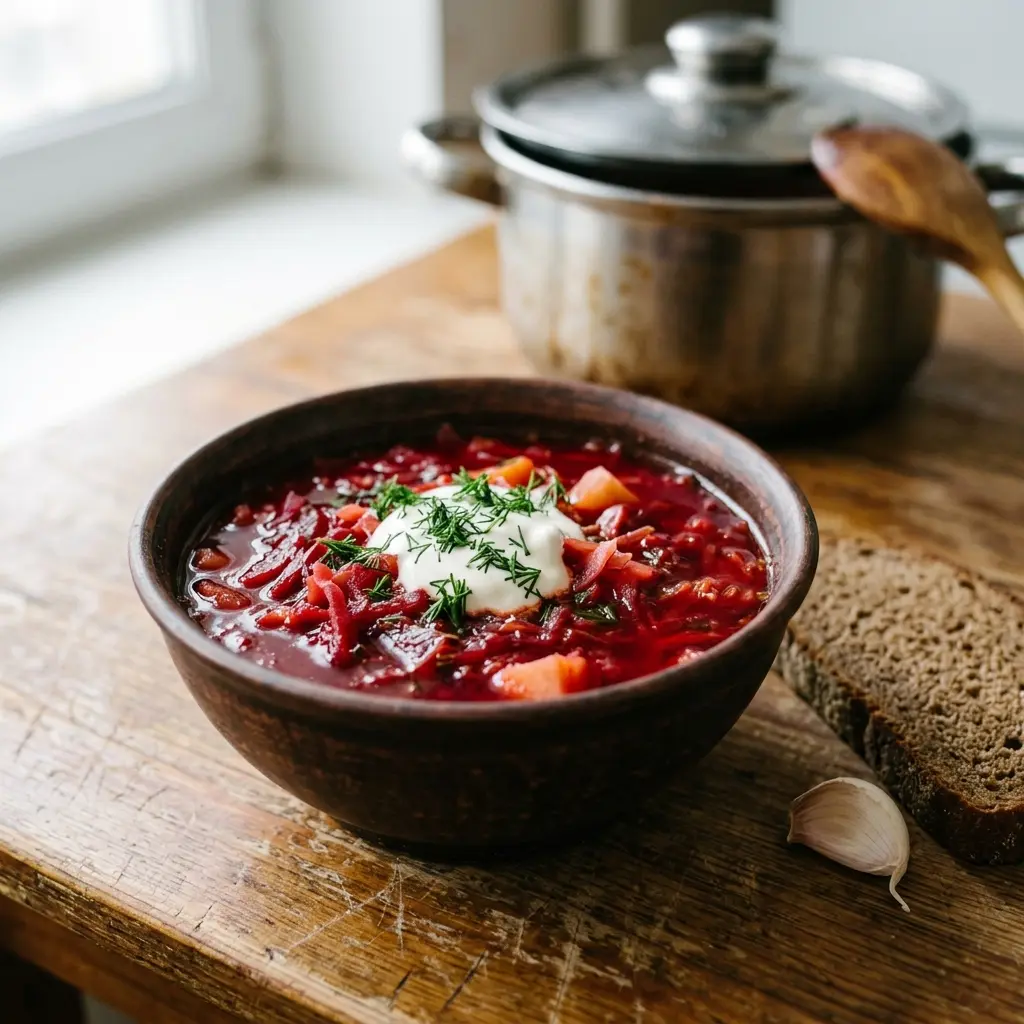
Ukrainian borscht is a thick, sour-sweet soup of beets, cabbage, potatoes, carrot and onion, simmered in a meat or vegetable broth and served with sour cream.
Ukrainian borschtборщsay borshchalso borsch, borshch, barszcz
The beets give it its deep red colour and a gentle sweetness; a little vinegar, lemon or fermented beet juice gives it the sour note that sets it apart from an ordinary vegetable soup. Most families cook it with beef or pork on the bone, and many cook it meatless with beans or mushrooms. It comes to the table with a spoon of sour cream, chopped dill and, in Ukraine, soft garlic buns called pampushky.
Borscht is eaten across Eastern Europe, and in Ukraine it is the soup of every day and every occasion. In 2022 UNESCO added the culture of Ukrainian borscht cooking to its List of Intangible Cultural Heritage in Need of Urgent Safeguarding.
This guide covers where borscht comes from, what the UNESCO listing says, how red and green borscht differ, the regional styles, whether to cook it with beef, and a full recipe for a pot that feeds eight.
Ukrainian borscht in short
- Ukrainian borscht is a beet soup with cabbage, potato, carrot and onion, soured with vinegar, lemon or beet kvass and served with sour cream.
- The word comes from the Slavic name for hogweed, the wild plant the first sour soups were made from; beets took its place over centuries.
- On 1 July 2022 UNESCO inscribed the culture of Ukrainian borscht cooking on its list of heritage in need of urgent safeguarding, noting it implies no exclusivity.
- Red borscht is built on beets; green borscht is a spring soup of sorrel with egg, and usually has no beets at all.
- Beef on the bone gives the richest broth; meatless borscht with beans or mushrooms is the Christmas Eve and Lent version.
- Borscht keeps 3 to 4 days in the fridge and tastes fuller on the second day.
Where does borscht come from?
The name is older than the beet soup. Borshch goes back to an old Slavic word for hogweed, a tall wild plant of damp meadows. Slavs gathered it in late spring, chopped the stems, leaves and flower heads, and left them in water to ferment, and the sour liquid became the base of a soup that took the plant’s name.
Beets arrived later. Garden beet varieties spread into Eastern Europe from about the sixteenth century, and over the next two hundred years beets and fermented beet juice slowly replaced hogweed in the pot. A Polish dictionary of 1806 was the first to define borscht as a tart soup made from pickled beets, and cabbage, potatoes and tomatoes joined the pot over time.
Some of the oldest written accounts come from the lands of today’s Ukraine. In 1584 Martin Gruneweg, a German merchant passing through Kyiv, noted that the locals rarely bought borscht, because everyone cooked their own at home as a staple food. The dish belongs to a wide region, and cooks in Poland, Lithuania, Romania, Moldova, Russia and Ashkenazi Jewish kitchens all have borscht of their own; which nation has the deepest claim is a question historians and cooks still argue about.
Why is Ukrainian borscht on the UNESCO list?
On 1 July 2022, at an extraordinary session, UNESCO’s Intergovernmental Committee for the Safeguarding of the Intangible Cultural Heritage inscribed the culture of Ukrainian borscht cooking on its List of Intangible Cultural Heritage in Need of Urgent Safeguarding. Ukraine had asked for the nomination to be examined on a fast track as a case of extreme urgency.
The inscription describes Ukrainian borscht as a dish cooked from broth with beetroot, sugar beet or fermented beet juice, made in a large pot and typically served with bread or garlic buns. It says the practice dates back centuries, is passed on within families with children helping in the kitchen, and appears in folk songs, tales, proverbs and ritual, such as wedding customs in the Podillia region.
The reason for urgency was the war. The Committee pointed to the displacement of the people who keep the tradition and to the damage to farmland that cut communities off from the local vegetables the dish depends on. The listing records the cultural importance of borscht to Ukrainians and states plainly that it does not imply exclusivity or ownership of the heritage.
What does borscht mean at a Ukrainian table?
Every family has its own borscht, and it is often the first real dish a child learns to cook. The saying goes that there are as many borschts as there are housewives, and villages and towns hold festivals where cooks compete over their pots.
Borscht marks the calendar too. A meatless red borscht made with mushrooms or beans is one of the twelve dishes of Sviata Vecheria, the Christmas Eve supper, when meat and dairy stay off the table. In spring, green sorrel borscht takes its place, and in summer, cold beet soups do.
It is also a dish of hospitality. UNESCO’s description puts it simply: borscht unites people of all ages, genders and backgrounds at the table.
What kinds of Ukrainian borscht are there?
- Classic red borscht with beef
- The everyday pot: beef shank or short ribs simmered into a broth, then beets, cabbage, potato, carrot, onion and tomato. The meat is cut up and returned to the bowls.
- Meatless borscht
- Vegetable or mushroom broth with white beans or dried mushrooms for depth. It is the Christmas Eve and Lenten borscht, and a good vegan soup if the sour cream is left out.
- Green borscht
- A spring soup of sorrel, potato and greens, sour from the sorrel itself, finished with hard-boiled egg and sour cream. It usually has no beets.
- Poltava borscht
- Associated with a poultry broth, chicken, duck or goose, in place of beef.
- Kyiv borscht
- Cooked with lamb or mutton as well as beef, with a rich, meaty broth.
- Chernihiv borscht
- Known for zucchini, beans and apples in the pot, with the beets sautéed in vegetable oil.
- Lviv borscht
- Built on a bone broth and served with chunks of Vienna sausage.
- Cold beet soup
- In summer, kholodnyk: boiled beets, cucumber, radish, green onion, dill and hard-boiled egg in chilled kefir or soured milk. It is a separate dish, eaten straight from the fridge on hot days.
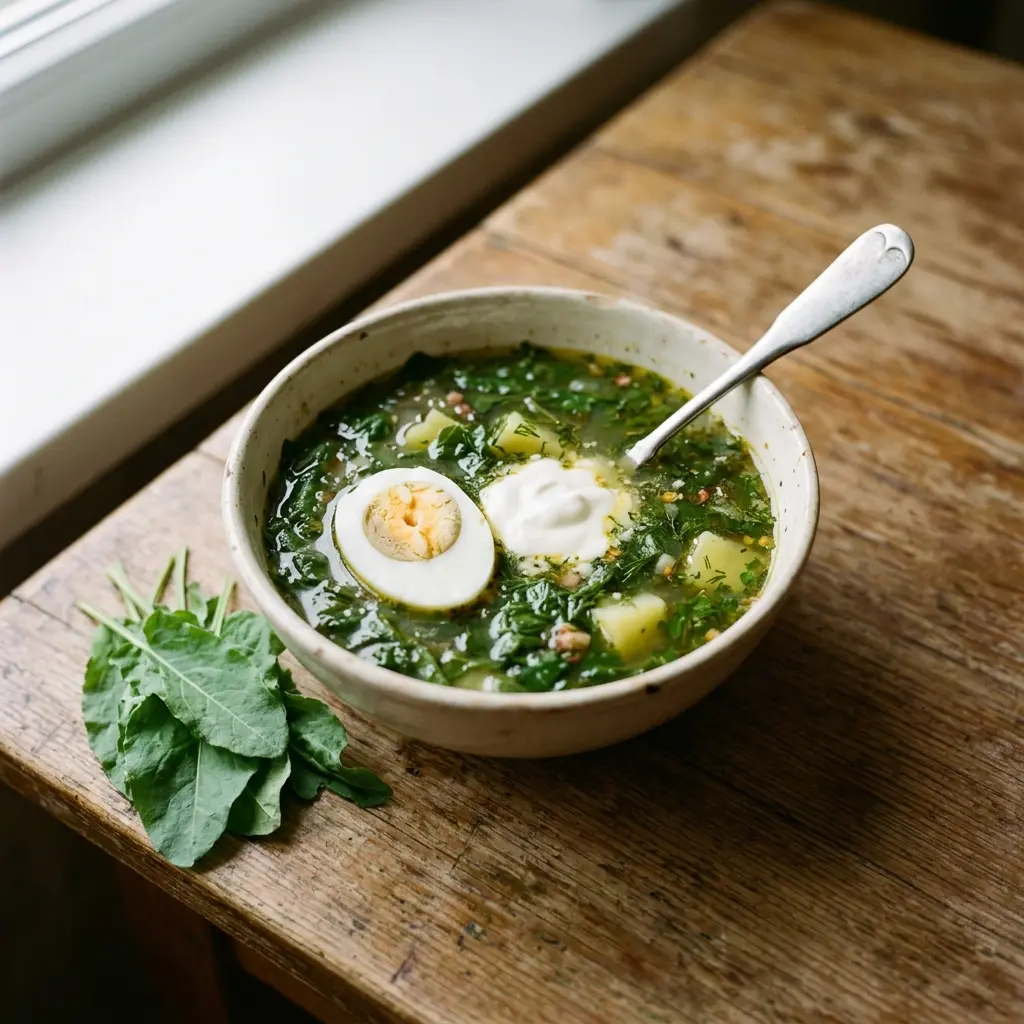
Red borscht and green borscht, side by side
| Item | Red borscht | Green borscht |
|---|---|---|
| Base | Beets, cooked with a sour element to hold the colour | Sorrel, sometimes with spinach, nettles or other spring greens |
| Other vegetables | Cabbage, potato, carrot, onion, often tomato or beans | Potato, carrot, onion, green onion, dill |
| Sourness from | Vinegar, lemon juice or fermented beet kvass | The sorrel itself |
| Broth | Beef or pork on the bone, poultry, or vegetables and mushrooms | Chicken, pork or vegetables |
| Finished with | Sour cream, dill, garlic | A chopped or halved hard-boiled egg and sour cream |
| Season | All year, and most of all in autumn and winter | Late spring and early summer, when sorrel is young |
The recipe
Ukrainian red borscht with beef
A classic pot of Ukrainian beet soup with beef, cabbage, potatoes and carrot, soured with vinegar and served with sour cream and dill.
Ingredients
Broth
- 700 g (1½ lb) bone-in beef shank or short ribs
- 3 litres (12 cups) cold water
- 1 bay leaf
- 6 black peppercorns
- 1 teaspoon salt
Vegetables
- 2 medium beets, about 500 g (1 lb)
- 3 medium potatoes, about 450 g (1 lb)
- 1 medium onion
- 1 large carrot
- ¼ small head green cabbage, about 400 g (6 cups shredded)
- 3 tablespoons sunflower or vegetable oil
- 2 tablespoons tomato paste
- 1 tablespoon white vinegar or lemon juice
- 1 teaspoon sugar
- 3 garlic cloves
- Salt and freshly ground black pepper
To serve
- Sour cream
- A small bunch of fresh dill, chopped
- Rye bread or garlic buns
Method
- 1
Start the broth
Put the beef in a large pot with the cold water and bring it slowly to a boil over medium heat, skimming off the grey foam as it rises.
- 2
Simmer the beef
Add the bay leaf, peppercorns and salt, lower the heat, cover partly and simmer for 1½ hours, until the meat is tender.
- 3
Prepare the vegetables
While the broth simmers, peel the beets and cut them into thin matchsticks, grate the carrot, dice the onion, cube the potatoes and shred the cabbage finely.
- 4
Take out the meat
Lift out the beef, strain the broth back into the pot and keep it at a gentle simmer. Cut the meat from the bone into bite-size pieces.
- 5
Cook the beets
Heat 2 tablespoons of the oil in a wide pan, add the beets with the vinegar and sugar, and cook over medium heat for 10 minutes, stirring often. The acid keeps them red.
- 6
Make the base
In a second pan, cook the onion and carrot in the remaining oil for 6 to 8 minutes until soft, then stir in the tomato paste and cook 2 minutes more.
- 7
Add the potatoes
Add the potatoes to the simmering broth and cook for 10 minutes.
- 8
Add the cabbage
Stir in the cabbage and cook for 5 minutes, until it just softens.
- 9
Bring it together
Add the beets, the onion and carrot base and the beef to the pot. Simmer gently for 10 minutes, without letting it boil hard.
- 10
Season
Crush the garlic into the soup, then taste and adjust with salt, pepper, a pinch of sugar or a little more vinegar, until it is pleasantly sweet and sour.
- 11
Rest and serve
Turn off the heat, cover the pot and let the borscht rest for 20 minutes. Serve it with sour cream, dill and bread.
Tips
- Thin matchsticks of beet keep their shape and colour; grated beets cook faster and melt further into the soup.
- For a meatless borscht, use vegetable broth with a can of white beans, rinsed, added with the cabbage, or a handful of dried mushrooms soaked and simmered in the broth.
- A cup of fermented beet kvass stirred in at the end gives the traditional sour note in place of vinegar.
- Make it a day ahead if you can. Borscht is better on the second day.
How do you serve and store Ukrainian borscht?
- Serve it hot, in deep bowls, with a spoon of sour cream added at the table and a pinch of chopped dill or parsley.
- Put bread on the table: pampushky, soft yeast buns brushed with garlic and oil, are the classic; dark rye bread is the everyday choice. Some people eat a clove of raw garlic or a slice of salt pork alongside.
- Let a fresh pot rest, covered and off the heat, for 20 to 30 minutes before serving. Borscht tastes fuller on the second day, when the flavours have settled.
- To store: cool it quickly, cover it and refrigerate within 2 hours. It keeps 3 to 4 days.
- To reheat: warm it gently over medium heat until it steams and just starts to bubble. A hard, long boil dulls the red.
- To freeze: up to 3 months in airtight containers with room at the top. Potatoes soften and turn grainy when frozen, so the soup is at its best frozen before the potatoes go in.
- To follow it: a plate of varenyky makes a full Ukrainian lunch, with a glass of cold kvass.
Common questions
What is Ukrainian borscht made of?
Beets, cabbage, potatoes, carrot and onion simmered in broth, usually beef or pork on the bone, with tomato, garlic and a sour element such as vinegar, lemon juice or beet kvass. It is served with sour cream and dill.
Is borscht Ukrainian or Russian?
Borscht is eaten across Eastern Europe, and its roots lie in the lands of today’s Ukraine, Poland and their neighbours; a German merchant visiting Kyiv in 1584 wrote that everyone there cooked their own at home as a staple food. In 2022 UNESCO recognised the culture of Ukrainian borscht cooking as Ukrainian heritage in need of urgent safeguarding, while noting the listing gives no country exclusive ownership of the dish.
What is the difference between red and green borscht?
Red borscht is made with beets, which give its colour and sweetness, and is soured with vinegar, lemon or beet kvass. Green borscht is a spring soup made with sorrel, which is sour on its own, and is finished with hard-boiled egg and sour cream.
Is borscht served hot or cold?
Ukrainian red borscht is served hot. Cold beet soups exist too, such as the Ukrainian summer soup kholodnyk and Lithuanian šaltibarščiai, made with beets, cucumber, egg and kefir or buttermilk; they are separate dishes.
How do you keep borscht red?
Add acid to the beets while they cook, such as a tablespoon of vinegar or lemon juice, and add the beets near the end so they simmer briefly. Long boiling without acid turns borscht brown or orange.
How long does borscht keep?
Three to four days in a covered pot or container in the fridge, and up to 3 months in the freezer. Potatoes turn a little grainy when frozen, so some cooks freeze the soup and add freshly cooked potato when they reheat it.
Sources
- Culture of Ukrainian borscht cooking — UNESCO Intangible Cultural Heritage
- Decision 5.EXT.COM 5 — UNESCO Intergovernmental Committee
- Culture of Ukrainian borscht cooking inscribed on the List — UNESCO
- Borscht — Encyclopaedia Britannica
- Borscht — Wikipedia
- Twelve-dish Christmas Eve supper — Wikipedia
- Cold beet soup — Wikipedia