
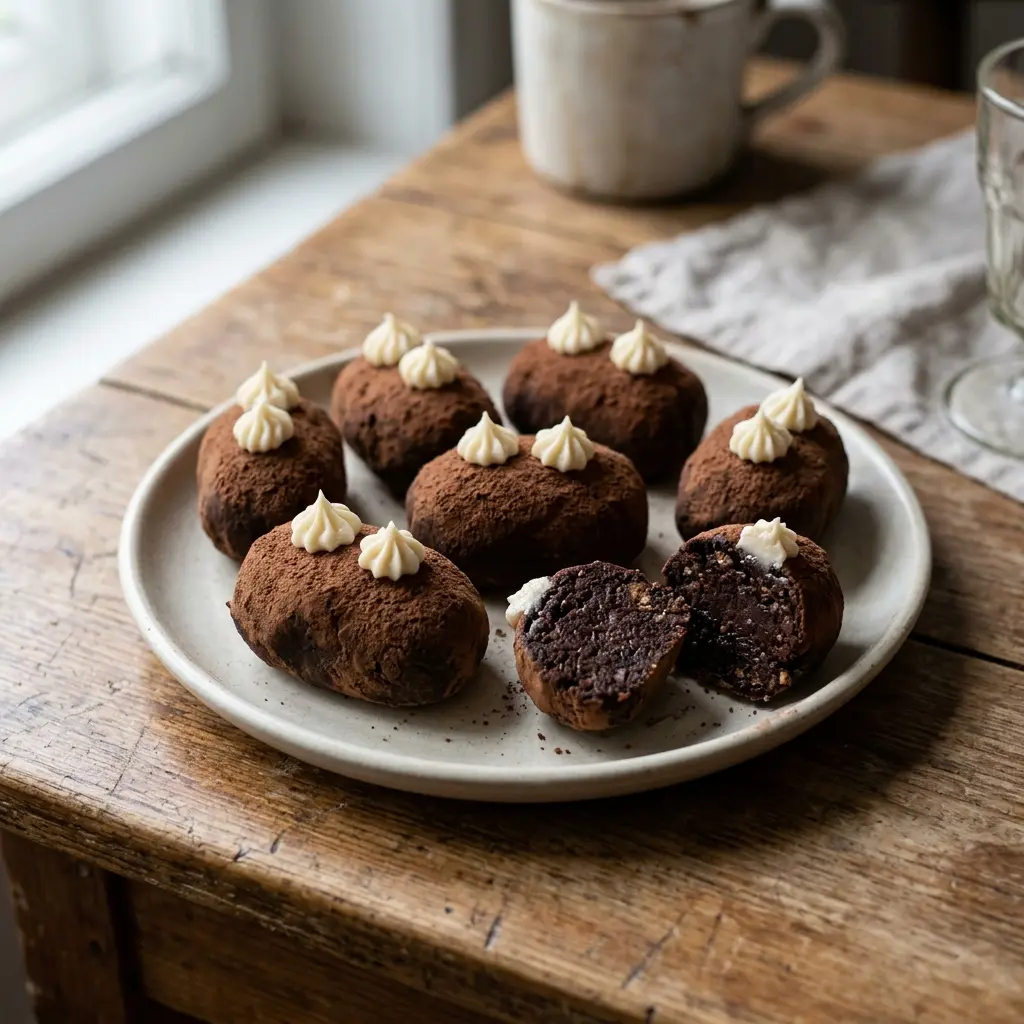
Kartoshka cake is a small no-bake pastry of sponge cake or cookie crumbs bound with butter and sweetened condensed milk, shaped like a potato and rolled in cocoa; there is no potato in it at all.
Kartoshka cakeтістечко «Картопля»also potato cake, kartoplia, pirozhnoe kartoshka, chocolate potato
The name is the Russian word for potato, and in Ukrainian the same cake is called kartoplia, which also means potato. The resemblance is the whole joke: a lumpy oval, dusted brown like a potato fresh from the garden, often with two little piped cream "sprouts" on top.
Inside, it tastes like a soft chocolate truffle with a cake crumb: sweet, buttery, milky from the condensed milk, and in the classic bakery version with a warm note of rum or cognac.
For anyone who grew up in Ukraine or elsewhere in the former Soviet Union, kartoshka is pure childhood: the pastry from the bakery counter, the cafeteria treat, and the cake a grandmother made from whatever cookies were in the cupboard. This guide explains where it comes from, the story it is often given, the two classic ways to make it, and a full home recipe.
Kartoshka cake in short
- Kartoshka ("potato") is a no-bake cake of crumbs, butter and condensed milk, rolled in cocoa.
- It contains no potato; the name comes from its shape and colour.
- Bakeries made it from sponge cake crumbs and butter cream; home cooks used plain cookies.
- It most likely began as a thrifty way to use leftover cakes and trimmings, and became a Soviet bakery staple.
- The story that it descends from Finland's Runeberg torte is unproven; that cake is baked.
- Kartoshka keeps up to 5 days in the fridge and freezes well.
Why is it called a potato cake?
Because it looks like one. Shaped by hand into an uneven oval and rolled in cocoa, a kartoshka has the size, the lumps and the dusty brown skin of a small potato just dug up. The two dots of pale cream on top are its sprouts. The name is a joke that children understand at once, and it has stuck.
In Russian the pastry is pirozhnoe kartoshka, "potato pastry", shortened to kartoshka. In Ukrainian it is tistechko kartoplia, with the same meaning. English-language bakeries and blogs mostly use the Russian form, so abroad the cake is best known as kartoshka.
Where does kartoshka cake come from?
Kartoshka began as a way to waste nothing. The culinary historian Pavel Syutkin traces it to the early 20th century, when pastry shops of the Russian Empire gathered up unsold cakes and trimmings, crumbled them, bound them with butter cream and rolled them in cocoa to hide their humble origin. He quotes a memoir of pre-revolutionary Baku describing exactly this: pastries left from the day before were collected, and "potato" cakes were made from them.
Soviet public catering gave the idea a system. Large bakeries produced sponge cakes every day, and the trimmings from cutting them had to go somewhere under strict rules on waste and yield. Crumbled sponge, butter cream made with condensed milk and a coating of cocoa became a standard pastry sold in bakeries, cafés and canteens, and kartoshka turned from leftovers into a classic in its own right.
At home the recipe changed again. Few families baked a sponge just to crumble it, so home cooks crushed plain cookies or vanilla rusks, mixed them with condensed milk and butter, and often added cocoa and nuts straight into the mixture. Recipes travelled from hand to hand, which is why no two families make kartoshka quite the same way.
Did kartoshka come from Finland?
You may read that kartoshka descends from the Runeberg torte, the small cake named after the Finnish poet Johan Ludvig Runeberg. His wife Fredrika Runeberg made it in Porvoo in the 1850s, and the story goes that she used up broken biscuits and crumbs to create it.
The link is a hypothesis, and the evidence for it is thin. The Runeberg torte is a baked cake of flour, breadcrumbs and ground almonds, soaked with rum or arrack and topped with raspberry jam in a ring of icing; kartoshka is never baked. Syutkin points out that the only thing they share is the use of crumbs, and that bread-crumb cakes appear in Russian cookbooks decades before the Runeberg torte. The safest summary is that thrifty bakers in many countries turned crumbs into cake, and kartoshka is the East European answer.
Kartoshka today
Kartoshka is still sold in bakeries across Ukraine and in Eastern European delis in Canada, and it is one of the most made-at-home desserts of the region: no oven needed, children can help shape it, and a pack of cookies and a can of condensed milk turn into a plate of cakes in half an hour.
Modern bakers dress it up with chocolate glaze, chopped nuts, dried fruit or coloured icing, and some shape it into small round truffles. The oblong cocoa-dusted potato with two cream sprouts remains the version people recognise.
What kinds of kartoshka cake are there?
- Sponge-crumb kartoshka (the bakery classic)
- A plain sponge cake is baked, dried and crumbed, then mixed with a butter cream of butter and sweetened condensed milk, flavoured with rum or cognac and a little cocoa. The cakes are rolled in cocoa mixed with icing sugar and finished with two piped cream sprouts. Soft, fine-textured and rich.
- Cookie-crumb kartoshka (the home version)
- About 400 g (14 oz) of plain dry cookies crushed fine, 150 g (⅔ cup) soft butter, about 200 ml (¾ cup) sweetened condensed milk and 2 to 3 tablespoons of cocoa, often with 50 g (½ cup) chopped walnuts. In Canada, Maria cookies, arrowroot biscuits or plain tea biscuits work best. Firmer and sweeter than the sponge version, and ready in half an hour.
- Leftover-cake kartoshka
- The original idea: any plain cake scraps, sponge offcuts or the trimmings from a medovik can be crumbled and used. Cakes with jam or fruit make a wetter mixture, so add crumbs a spoonful at a time.
- Glazed kartoshka
- Instead of a dusting of cocoa, the shaped cakes are dipped in melted dark chocolate or a cocoa glaze. They look neater and keep their coating better in a warm room.
- With nuts or dried fruit
- Toasted walnuts or hazelnuts, or raisins soaked in rum, are worked into the mixture. A roasted nut can also sit in the centre of each cake.
- Kartoshka truffles
- The same mixture rolled into small balls, coated in cocoa, chopped nuts or coconut, and served in paper cases. Popular for children's parties and gift boxes.
The recipe
Classic kartoshka cake with sponge crumbs
A plain sponge dried into crumbs, bound with condensed-milk butter cream, shaped into little potatoes and rolled in cocoa.
Ingredients
Sponge
- 4 large eggs, at room temperature
- 120 g (½ cup plus 2 Tbsp) granulated sugar
- A pinch of salt
- 1 tsp vanilla extract
- 120 g (1 cup) all-purpose flour
Butter cream
- 150 g (⅔ cup) unsalted butter, very soft
- 150 g (½ cup) sweetened condensed milk, at room temperature
- 1 Tbsp rum or cognac, or ½ tsp rum extract (optional)
- 1 Tbsp cocoa powder
Coating
- 2 Tbsp cocoa powder
- 1 Tbsp icing sugar
Method
- 1
Prepare the pan
Heat the oven to 180°C (350°F) and line a 23 cm (9 in) round or square cake pan with baking paper.
- 2
Whip the eggs
Beat the eggs with the sugar and salt on high speed for 8 to 10 minutes, until pale, thick and tripled in volume, so the batter falls from the whisk in a ribbon. Beat in the vanilla.
- 3
Fold in the flour
Sift the flour over the eggs in three additions, folding each one in gently with a spatula until no dry streaks remain.
- 4
Bake the sponge
Pour the batter into the pan and bake for 25 to 30 minutes, until golden and springy and a skewer comes out clean. Cool completely on a rack.
- 5
Dry and crumb the sponge
Tear the sponge into pieces and dry them in a 120°C (250°F) oven for 15 minutes, or leave them uncovered overnight. Cool, then grind to fine crumbs in a food processor. You need about 300 g (3 cups).
- 6
Make the butter cream
Beat the soft butter for 3 minutes until pale and fluffy. Add the condensed milk a spoonful at a time, beating after each, then beat in the rum.
- 7
Set aside the sprouts
Spoon 3 tablespoons of the plain butter cream into a small piping bag or a sandwich bag, and keep it in the fridge.
- 8
Mix the dough
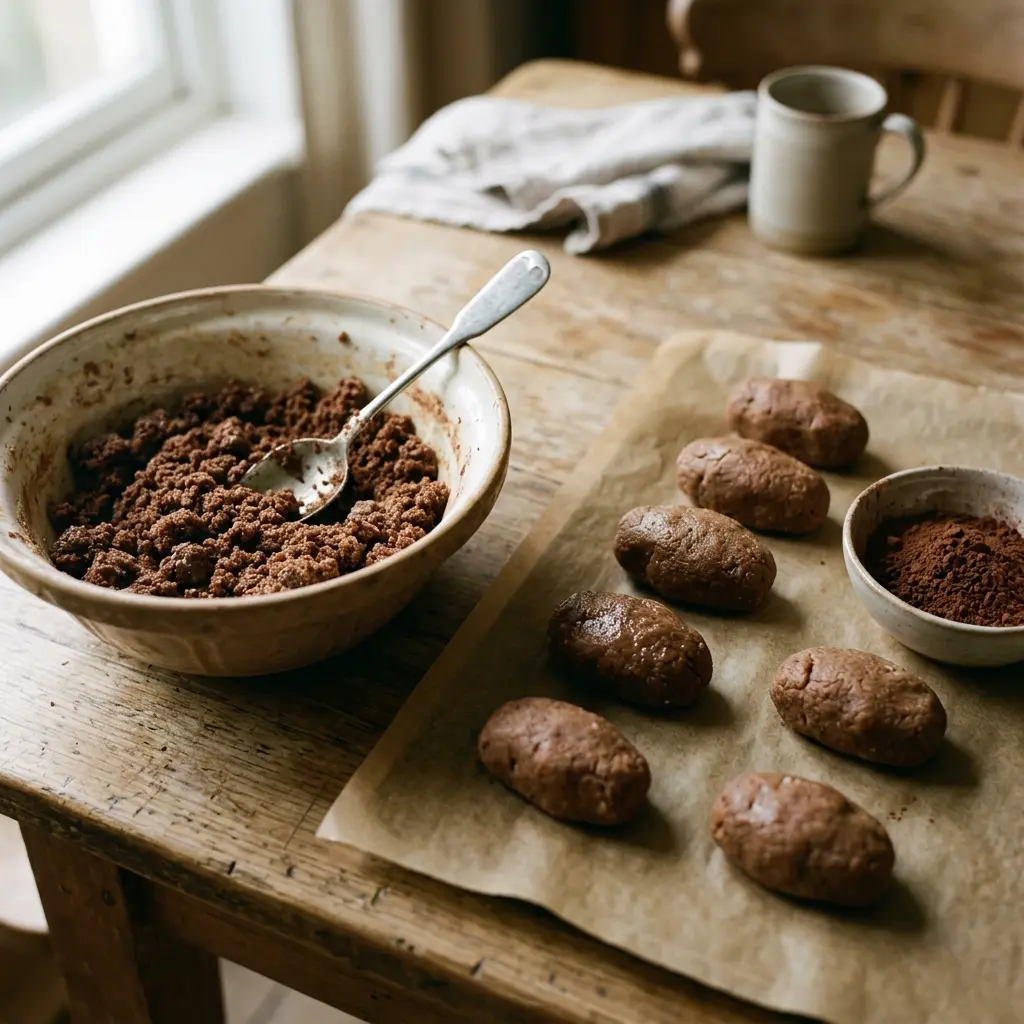
Beat the cocoa into the remaining butter cream, then work in the crumbs with a spatula or your hands until the mixture holds together like soft modelling clay.
- 9
Shape the potatoes
Divide the mixture into 12 pieces of about 50 g. Roll each into an oblong, then press it unevenly with your fingers so it looks like a small potato.
- 10
Chill
Set the cakes on a plate and refrigerate for 30 minutes, until firm.
- 11
Coat in cocoa
Mix the cocoa with the icing sugar in a shallow bowl and roll each cake in it until evenly dusted.
- 12
Pipe the sprouts
Snip a small corner off the piping bag and pipe two small dots of cream on top of each cake. Chill for 30 minutes more before serving.
Tips
- The total time includes cooling the sponge and two short chills; the hands-on work is about 40 minutes.
- If the mixture is too soft to shape, add crumbs a spoonful at a time; if it cracks, add a spoon of condensed milk.
- Butter and condensed milk at the same room temperature keep the cream from splitting.
- A store-bought plain sponge or pound cake, dried in the oven, is a good shortcut.
- Wet hands, or hands lightly dusted with cocoa, stop the mixture from sticking while you shape.
How do you serve and store kartoshka cake?
- Serve kartoshka chilled, then let the cakes stand for 10 to 15 minutes so the butter softens and the flavour comes through.
- One cake per person with tea or coffee is the traditional portion; they are rich.
- Keep them covered in the fridge for up to 5 days. The cocoa coating soaks in over time, so dust again before serving if needed.
- Freeze in a single layer, then transfer to a container, for up to 2 months. Thaw in the fridge for a few hours.
- For a party, set each cake in a paper case so the cocoa stays off fingers.
- The butter cream softens in heat, so on a warm day keep the plate out of the sun and bring out a few at a time.
Common questions
Is there potato in kartoshka cake?
No, kartoshka cake contains no potato. The name means "potato" and describes its look: an uneven oval coated in cocoa, like a potato just out of the soil, with two cream "sprouts" on top. The inside is cake or cookie crumbs, butter, condensed milk and cocoa.
What are the white swirls on top of kartoshka?
Two small piped dots of butter cream, set aside plain before the cocoa goes into the mixture. They stand for the sprouts, or eyes, of a potato. Some bakeries skip them, and some pipe them in coloured icing.
Does kartoshka cake contain alcohol?
Often a little. The classic bakery recipe flavours the butter cream with rum or cognac, about a tablespoon for a dozen cakes, and since the cakes are never baked the alcohol stays in. Home versions for children leave it out or use a drop of rum extract or vanilla instead.
How long does kartoshka cake keep?
5 days in a covered container in the fridge, and up to 2 months in the freezer. Take them out 15 minutes before serving so the butter softens. Dust them with a little fresh cocoa if the coating has soaked in.
Can you make kartoshka with cookies instead of cake?
Yes, and it is the most common home method. Use about 400 g (14 oz) of plain, dry cookies such as Maria, arrowroot or tea biscuits, crushed fine, with butter, condensed milk and cocoa. Cookie kartoshka is a little firmer and sweeter than the sponge version.
Is kartoshka cake Russian or Ukrainian?
It is a Soviet-era pastry shared by all the countries that were part of the USSR, including Ukraine, where it is called kartoplia. In English it usually goes by its Russian name. Historians trace it to early 20th-century pastry shops of the Russian Empire, and a Finnish origin has been suggested without proof.
Sources
- Pavel Syutkin, "Крошка-картошка (история одного пирожного)" (blog)
- Sankt-Peterburgskie Vedomosti, "Финский иноземец. История пирожного «Картошка»"
- Runeberg torte — Wikipedia
- Gastronom.ru, pirozhnoe Kartoshka by the Soviet standard (proportions)
- That's What She Had, "Soviet Kartoshka, or Why Russians Eat Potato for Dessert"
- Folkways, "Kartoshka Cake — The Potato-esque Russian Pastry"
- Atlas Obscura, "The Chocolate 'Potato' Soviet Children Dreamed About"