
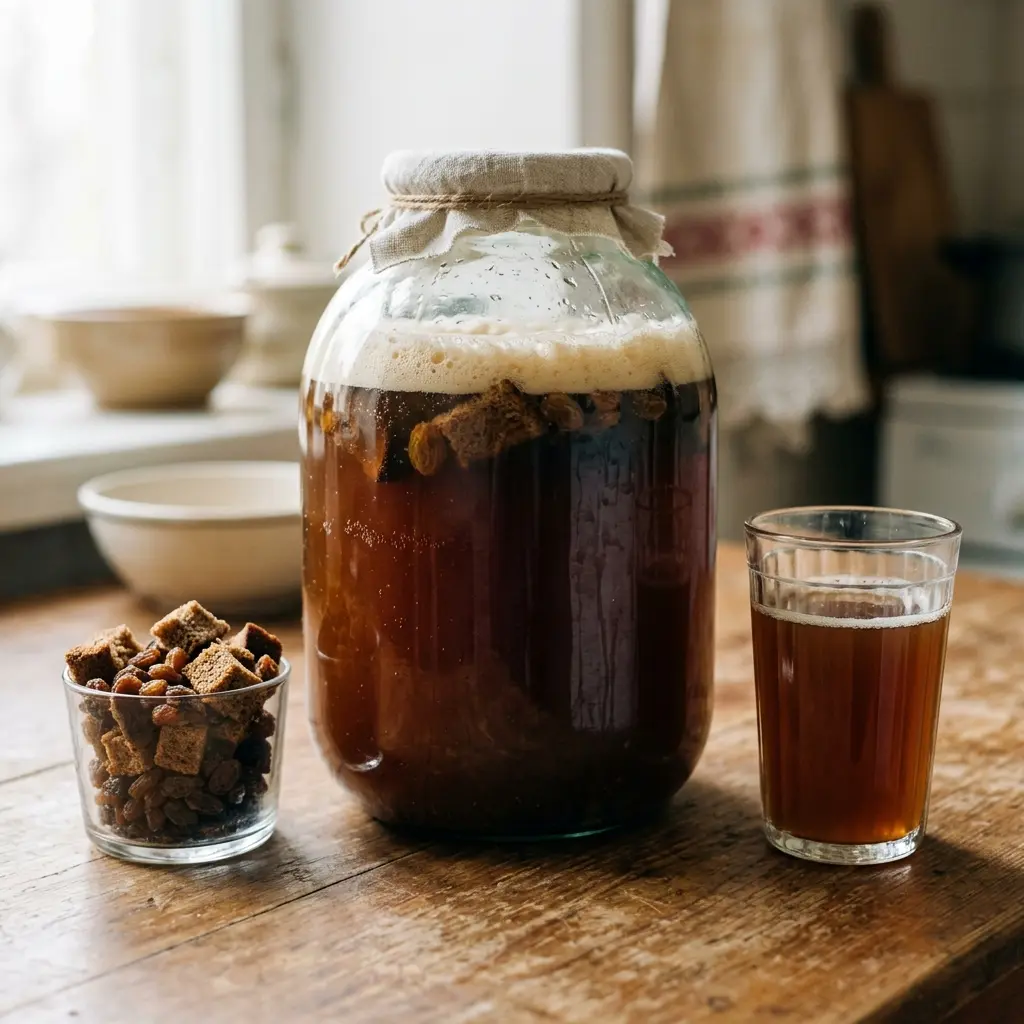
Kvass is a traditional fermented drink made from rye bread, water, sugar and yeast: dark amber, lightly fizzy, sweet and sour at once, and very low in alcohol.
Kvassквасsay kvahsalso kvas, kwas, bread kvass
It tastes a little like a soft, malty brown bread in liquid form, with a sourness close to a light sour beer and a finish of caramel and toasted crust. It is drunk ice-cold, most of all in summer, and in Ukraine it has quenched the thirst of haymakers, city crowds and families at the table for about a thousand years.
The name means “the sour one”, and the family is wider than the bread drink. Ukrainian cooks also ferment beets into a kvass that sours borscht, and in the past made kvass from pears and apples. English spells it kvass or kvas; both are the same drink.
This guide covers where kvass comes from, whether it is alcoholic, how bread kvass is made, how bottled kvass compares with homemade, and a recipe for about three litres from a loaf of dark rye.
Kvass in short
- Kvass is a fermented drink of rye bread or rye malt, water, sugar and yeast, drunk cold.
- It is low in alcohol: fermented kvass is typically 0.5 to 1.5%, and homemade kvass grows stronger the longer it ferments.
- It tastes malty, gently sweet and tangy, with a toasted-bread finish and a light fizz.
- Kvass appears in the Primary Chronicle of Kyivan Rus, handed out in Kyiv with mead and bread.
- Homemade bread kvass takes about a day: dry the bread, steep it, ferment the liquid 12 to 24 hours, bottle it for fizz, chill.
- Bottled kvass ranges from fermented kvass to kvass-flavoured soft drinks; the ingredient list tells you which.
Where does kvass come from?
Kvass is one of the oldest drinks of the Slavic world. Its name goes back to an ancient root meaning to turn sour, the same root that runs through the Ukrainian words for fermenting and pickling, so kvass is, quite literally, the sour drink.
It appears in the oldest surviving chronicle of Kyivan Rus. The Primary Chronicle, compiled in Kyiv in the early twelfth century, tells how Prince Volodymyr the Great, after the Christianisation of Kyivan Rus, had carts loaded with bread, meat, fish, vegetables, mead in casks and kvass, and driven through the city to the poor and the sick who could not come to his court.
The word reached English in 1553, spelled quass, and by then kvass had long been the everyday drink of the region, made at home from whatever grain and bread a household had.
How was kvass part of Ukrainian life?
Kvass was the drink of the field and the kitchen. A household kept a crock of it going through the summer, feeding it with stale rye bread, and carried jugs of it out to the fields at haymaking. Old rye crusts that would otherwise be thrown away became the next batch.
Ukrainian kitchens fermented more than bread. Beet kvass, made by covering sliced beets with water and leaving them for several days, was drunk on its own and, above all, used to give borscht its sour, deep-red base. Pear and apple kvass were traditional too, and later recipes added mint, honey, raisins or berries; historical recipe collections record more than 150 kinds, from apple and pear to mint, raspberry and cherry.
In the twentieth century kvass moved onto the street. In Soviet times it was sold in cities across Ukraine from large tank barrels on wheels, poured by the glass or into jars and bottles that people brought from home, and a mug of it on a hot afternoon became a summer memory for generations. Today most kvass in Ukraine and abroad is bottled, from small brewery kvass to big soft-drink brands, and bread kvass is still made at home.
Is bottled kvass the same as homemade?
Bottled kvass covers a wide range. At one end is fermented kvass, brewed from rye malt and bread, filtered and bottled; at the other are kvass drinks blended from water, sugar and kvass concentrate and carbonated like a soda. Latvia, where kvass is also popular, defined the difference in law in 2010: kvass is fermented from kvass wort, with no more than 1.2% alcohol, and an unfermented mixture must be labelled a kvass beverage.
The ingredient list tells you which you have. The Ukrainian-market label of Monastyrskyi, a 2 litre bottled kvass sold in Ukraine, lists prepared water, sugar, citric acid and fermented kvass concentrate, with a shelf life of 180 days. Bottled kvass of this kind is sweeter, clearer and more consistent than homemade, and keeps for months unopened.
Homemade bread kvass is cloudier and livelier. It tastes more of bread and more sour, carries a little more alcohol, and changes from one day to the next as the yeast keeps working, which is why it is made in small batches and drunk within a few days.
What kinds of kvass are there?
- Bread kvass
- The classic, made from dark rye bread dried in the oven, water, sugar and yeast. The darker the bread is toasted, the darker and more caramel the kvass.
- Beet kvass
- Sliced beets fermented in water, sometimes with a crust of rye bread to start it. Deep red and salty-sour, it is a traditional base for borscht and is also drunk in small glasses.
- Pear and apple kvass
- A traditional Ukrainian fruit kvass, fermented from fresh or dried pears and apples with sugar or honey. Lighter in colour and gently fruity.
- Mint kvass
- Bread kvass with a handful of fresh mint added during fermentation, for a cooler, brighter taste on hot days.
- Honey and raisin kvass
- Honey takes the place of some or all of the sugar, and raisins go into the bottles to feed a stronger fizz.
- Berry kvass
- Bread or plain kvass fermented with raspberries, cherries or currants, pink and tart.
- Malt kvass
- Made from dried rye malt or kvass concentrate in place of bread. Quicker and more consistent; this is how most bottled kvass begins.
Homemade bread kvass and bottled kvass, compared
| Item | Homemade bread kvass | Bottled kvass |
|---|---|---|
| Made from | Dark rye bread dried in the oven, water, sugar, yeast, often raisins | Water, sugar and kvass wort concentrate or rye malt, sometimes with added flavourings and acid |
| Fermentation | Live yeast, 12 to 24 hours, then a few hours in the bottle | Fermented and filtered, or blended from concentrate; often pasteurised |
| Fizz | Soft, from its own fermentation | Usually carbonated, livelier and more even |
| Taste | Deeper, breadier and more sour; changes from day to day | Sweeter and consistent from bottle to bottle |
| Alcohol | Around 0.5 to 1.5%, rising if left warm | Varies by brand; check the label |
| Keeps | 3 to 5 days in the fridge | Months unopened; best drunk within a few days of opening |
The recipe
Homemade bread kvass
Traditional Ukrainian kvass fermented from dark rye bread, sugar and yeast, bottled with raisins for a light natural fizz.
Ingredients
For the kvass
- 500 g (1 lb) dark rye bread, such as a dense Borodinsky-style or dark pumpernickel loaf
- 3.5 litres (14 cups) water
- 150 g (¾ cup) sugar
- 1 teaspoon (3 g) active dry yeast
For bottling
- 2 to 3 raisins per bottle
- 1 teaspoon sugar per bottle, optional, for more fizz
- A few fresh mint leaves, optional
Method
- 1
Dry the bread
Slice the bread and lay it on a baking sheet. Dry it in the oven at 180 °C (350 °F) for 20 to 30 minutes, until very dark and crisp, without letting it burn.
- 2
Boil the water
Bring the water to a boil, then let it stand for about 5 minutes off the heat.
- 3
Steep the crusts
Put the dried bread in the pot or jar and pour the hot water over it. Cover with a clean cloth.
- 4
Leave it to infuse
Leave it at room temperature for 6 to 8 hours or overnight, until the liquid is dark and completely cool.
- 5
Strain
Strain the liquid through a sieve lined with cheesecloth, pressing the bread gently. Squeezing it hard makes the kvass cloudy.
- 6
Sweeten
Stir the sugar into the strained liquid until it dissolves.
- 7
Wake the yeast
Mix the yeast with half a cup of the lukewarm liquid and a pinch of sugar, wait 10 minutes until it foams, then stir it into the rest.
- 8
Ferment
Cover with the cloth and leave at room temperature for 12 to 24 hours, until the top is foamy and the kvass tastes pleasantly sour.
- 9
Bottle
Strain again into clean bottles, add 2 to 3 raisins to each, and the sugar and mint if using. Leave 5 cm (2 inches) of space at the top and close tightly.
- 10
Build the fizz
Leave the bottles at room temperature for 6 to 12 hours, until a plastic bottle feels firm when squeezed.
- 11
Chill
Move the bottles to the fridge and chill for at least 4 hours before drinking. Drink within 3 to 5 days.
Tips
- You need a large pot or a 5-litre (5-quart) jar, a sieve lined with cheesecloth, and clean bottles with tight caps, about 3 litres in all.
- The bread decides the kvass. Plain dense dark rye gives the classic taste; breads with seeds, cheese or strong flavourings carry them into the glass.
- Toast the bread dark for colour and caramel flavour, and stop short of black, which turns the kvass bitter.
- Warmth speeds everything up. In a hot kitchen, check the ferment after 8 hours; in a cool one, give it the full day.
- The longer kvass ferments, the more sour and the more alcoholic it becomes. Chill it as soon as it tastes right to you.
- Plastic bottles are the safest for the fizzing stage, because you can feel the pressure build.
How do you serve and store kvass?
- Serve it cold, straight from the fridge at about 4 to 6 °C (40 to 43 °F), in a tall glass or a mug. Ice dilutes it; a chilled glass keeps it fizzy.
- Drink it on its own on a hot day, or with a meal: kvass goes well with varenyky, with salty dishes such as salt pork, pickles and smoked fish, and after a bowl of borscht.
- Pour slowly. Homemade kvass carries fine sediment from the bread and yeast, and the last centimetre of the bottle is best left behind.
- To store homemade kvass: keep it in the fridge in closed bottles and drink it within 3 to 5 days. Open plastic bottles once a day to let out the pressure.
- To store bottled kvass: unopened, follow the date on the bottle; once opened, close it tightly, keep it cold and finish it within a couple of days, while it is still fizzy.
- To cook with it: beet kvass sours borscht, and plain unsweetened kvass is used across the region as the base of cold summer soups.
Common questions
Is kvass alcoholic?
Only slightly. Naturally fermented kvass usually contains 0.5 to 1.5% alcohol and occasionally up to 2%, well below beer at around 5%. Homemade kvass gets stronger the longer it ferments at room temperature, and bottled kvass states its strength on the label, so anyone avoiding alcohol entirely should check before drinking it.
What does kvass taste like?
Like dark rye bread in a glass: malty and gently sweet, with a tangy, lightly sour edge, a caramel and toasted-crust finish, and a soft fizz. Homemade kvass is breadier and more sour; bottled kvass is usually sweeter and more carbonated.
What is kvass made from?
Traditional bread kvass is made from dark rye bread or rye malt, water, sugar and yeast, sometimes with raisins or mint. Ukrainian cooks also make beet kvass from fermented beets and, in the past, fruit kvass from pears and apples.
Is kvass the same as beer?
They are cousins, both fermented from grain with yeast. Kvass is fermented briefly from bread, is usually sweet and unhopped, and stays low in alcohol, around 0.5 to 1.5% against about 5% for beer.
How long does homemade kvass last?
Three to five days in the fridge in closed bottles. It keeps fermenting slowly, so it grows more sour, fizzier and a little stronger each day; open plastic bottles now and then to let the pressure out.
Can kvass be used in borscht?
Beet kvass can. A cup of fermented beet kvass stirred into red borscht near the end gives its traditional sour note and deepens the colour. Sweet bread kvass stays in the glass.
Sources
- Kvass — Wikipedia
- Kvass — Encyclopaedia Britannica
- The Russian Primary Chronicle, trans. Cross and Sherbowitz-Wetzor — University of Oregon
- Kvas Monastyrskyi 2 L — MegaMarket (label listing)
- Borscht (beet sour) — Wikipedia
- Bread Kvass — Peter’s Food Adventures