
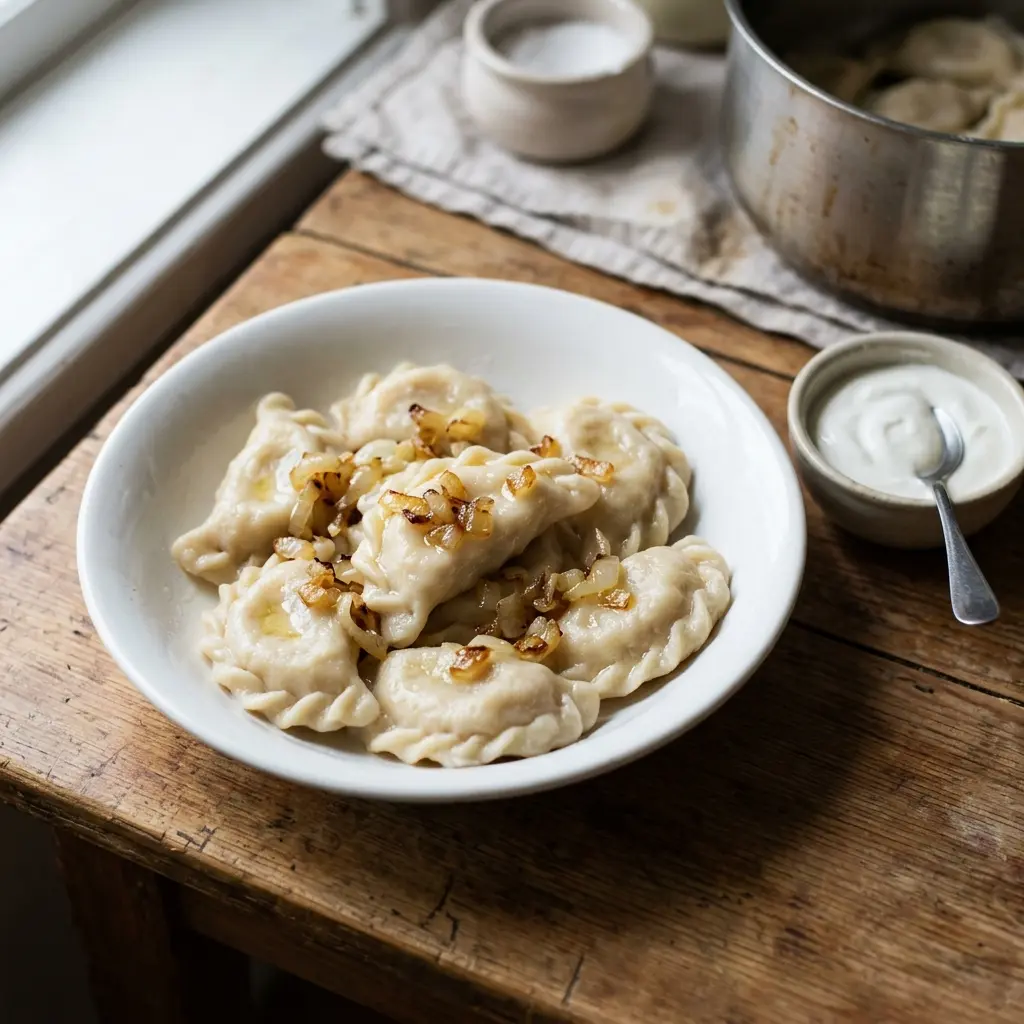
Varenyky are Ukrainian dumplings: circles of soft, thin dough folded over a filling, pinched shut into a half-moon and boiled.
Varenykyвареникиsay vah-REH-nih-kihalso vareniki, pyrohy, perogies, pierogi
The everyday fillings are mashed potato with fried onion, potato with cheese, farmer’s cheese and sauerkraut, and in summer sour cherries. Savoury varenyky come to the table glossy with melted butter, under a spoon of onion fried golden, with a bowl of sour cream beside them.
The name comes from the Ukrainian verb varyty, to boil, which is how nearly every varenyk is cooked. They are a weeknight supper, a dish for harvest and wedding tables, and one of the meatless courses of Christmas Eve. Families still make them together by the hundred, freezing whatever they will not cook that day.
Much of Canada knows them as perogies. This guide covers where varenyky come from, how they relate to Polish pierogi, the fillings and customs, a full recipe for potato varenyky, and the exact way to cook a bag of frozen ones so every dumpling comes out tender and whole.
Varenyky in short
- Varenyky are boiled half-moon dumplings of thin, soft dough; the name comes from varyty, “to boil”.
- Savoury fillings: potato and fried onion, potato and cheese, farmer’s cheese, sauerkraut, mushrooms. Sweet ones: sour cherries, sweetened farmer’s cheese, poppy seed, berries.
- Cook frozen varenyky straight from the freezer in plenty of salted water at a rolling boil, then 2 to 3 minutes more once they float: about 6 to 8 minutes in all.
- Serve savoury varenyky with melted butter, onion fried golden and sour cream; fry leftovers in butter the next day.
- Pierogi are the Polish relative. In western Ukraine and on the Canadian Prairies, pyrohy and perogies are other names for the same dumpling.
Where do varenyky come from?
The first varenyk cannot be dated. Dough wrapped around a filling and cooked in water is one of the oldest ideas in the kitchens of Eurasia, and food historians still argue over how it travelled west. One school traces filled dumplings to China and the trade routes of the Silk Road; another reads the Slavic word pyrih, and the Polish pierogi, as borrowings from the Turkic börek. Polish tradition keeps a legend that Saint Hyacinth brought pierogi home in the thirteenth century. Each of these is a theory, and none has a document that settles it.
What is certain is the name. Varenyky takes its root from varyty, to boil, so the dish is named for the way it is cooked. The word pyrih, which in modern Ukrainian means a baked pie, survives as pyrohy in Galicia and the Carpathian west of Ukraine, where it still names the boiled dumpling, and this is the word Ukrainian settlers carried to the Canadian Prairies in the late nineteenth and early twentieth centuries.
By the time Nikolai Gogol published his Ukrainian tales in 1832, varenyky were so much a part of village life that he could build a joke on them. In the story Christmas Eve, the blacksmith Vakula visits pot-bellied Patsiuk, a Cossack rumoured to deal with the devil, and finds him sitting before a bowl of varenyky that jump out one by one, flip over in the sour cream and fly straight into his open mouth.
Are varenyky the same as pierogi?
They are family. Poland’s pierogi and Ukraine’s varenyky are both boiled, filled dumplings of unleavened dough, and they share most of their fillings. Poland’s first printed cookbook, Compendium ferculorum of 1682, already carries pierogi recipes. The best-known Polish kind, pierogi ruskie, filled with potato, curd cheese and onion, is named for Ruthenia, the historical region that includes western Ukraine; English menus often mistranslate it as Russian.
Cooks on both sides of the border will tell you the difference is in the hand. Ukrainian varenyky tend to have a thinner, softer dough, often loosened with a little oil, sour cream or kefir, and simpler fillings, with potato the most common by far. Sizes, shapes and crimps vary from one family to the next more than from one country to the next.
In Canada the words blur. Ukrainian families in Alberta, Saskatchewan and Manitoba made perogy the everyday English word, parish halls sold them by the dozen at fundraisers, and in 1993 the village of Glendon, Alberta, put up a giant fibreglass perogy on a fork by the road.
What do varenyky mean in Ukrainian tradition?
Varenyky belong to the table on the days that matter. On Christmas Eve, Ukrainian families sit down to Sviata Vecheria, the Holy Supper of twelve dishes kept free of meat, eggs and dairy, and varenyky filled with potato, sauerkraut, mushrooms or poppy seed are among them. Poppy seed, in folk belief, carries a wish for prosperity and plenty in the year ahead.
Making them is a social job. Rolling, cutting, filling and pinching a hundred varenyky goes quickly with four pairs of hands and slowly with one, so the work is shared across generations at a kitchen table, and children learn the pinch before they learn the dough. Some cooks hide a coin or a surprise filling in a single dumpling for someone lucky to find.
The dish has its own monument. In Cherkasy, in central Ukraine, a ceramic statue unveiled in 2006 shows the folk hero Cossack Mamay eating varenyky from a clay pot, with a huge half-moon varenyk rising behind him.
What kinds of varenyky are there?
- Potato and fried onion
- The everyday classic: floury potatoes mashed with onion cooked slowly in butter or oil until golden, seasoned with salt and black pepper.
- Potato and cheese
- Mashed potato folded with farmer’s cheese or, in many Canadian kitchens, sharp aged cheddar. The cheese makes the filling richer and a little tangy.
- Farmer’s cheese
- Fresh curd cheese mixed with an egg yolk, served savoury with dill and salt, or sweet with sugar and a pinch of vanilla or raisins.
- Sauerkraut and mushroom
- Sauerkraut squeezed dry and fried with onion, often with wild mushrooms. It is a winter filling and a Christmas Eve favourite, since it contains no meat or dairy.
- Sour cherry
- The summer varenyk: pitted sour cherries with a little sugar, sealed tightly because the juice runs. They are eaten warm or cold with sour cream and sugar, and the purple juice in the bowl is part of the pleasure.
- Poppy seed
- Ground poppy seed sweetened with honey or sugar, made for Christmas Eve, when poppy seed stands for a prosperous year.
- Meat
- Cooked minced pork or beef with onion, or leftover roast. Less common in Ukraine than potato or cheese, and a good use for leftover meat.
- Lazy varenyky
- A shortcut with no filling at all: farmer’s cheese, egg and a little flour kneaded into a soft dough, rolled into a rope, cut into small pieces and boiled, then served with butter and sour cream. Children love them.
How to cook frozen varenyky, step by step
| Step | What to do | How long |
|---|---|---|
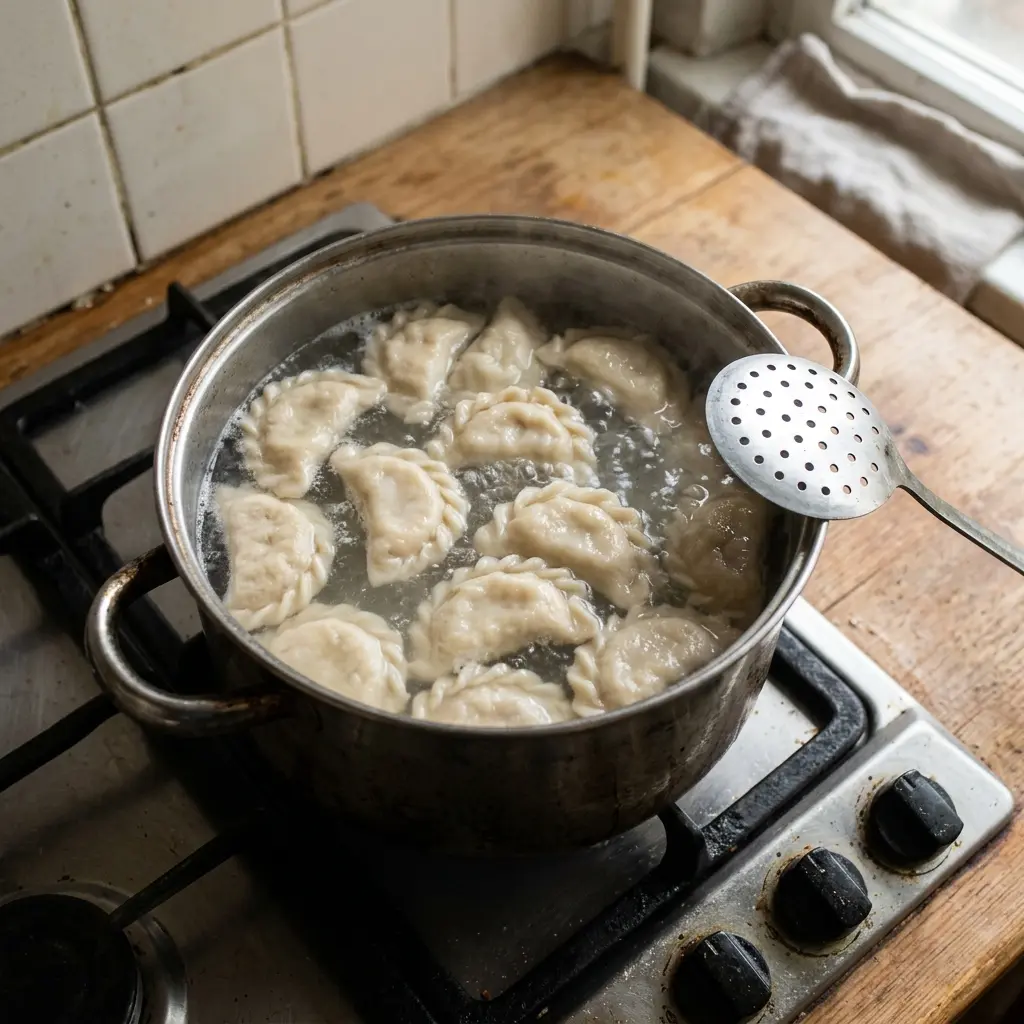
| 1. Boil the water | Fill a large pot with at least 3 litres (12 cups) of water, add 1 tablespoon of salt and bring it to a full rolling boil. | 10 to 12 minutes |
| 2. Add them frozen | Take the varenyky straight from the freezer, still frozen, and slide up to 20 of them into the water a few at a time, so the boil keeps going. | About 1 minute |
| 3. Stir once | Run a slotted spoon gently along the bottom of the pot so none of them stick to the base or to each other. | Right away |
| 4. Wait for the float | Keep the water at a steady boil. The varenyky sink first, then rise to the surface as the dough cooks and the filling heats through. | 3 to 5 minutes |
| 5. Boil past the float | Once they are all floating, boil them 2 to 3 minutes more. Bite the thick pinched edge of one: it should be tender right through. | 2 to 3 minutes |
| 6. Lift and butter | Lift them out with the slotted spoon, let the water drip away and toss them in a warm bowl with melted butter so they stay separate. | 1 minute |
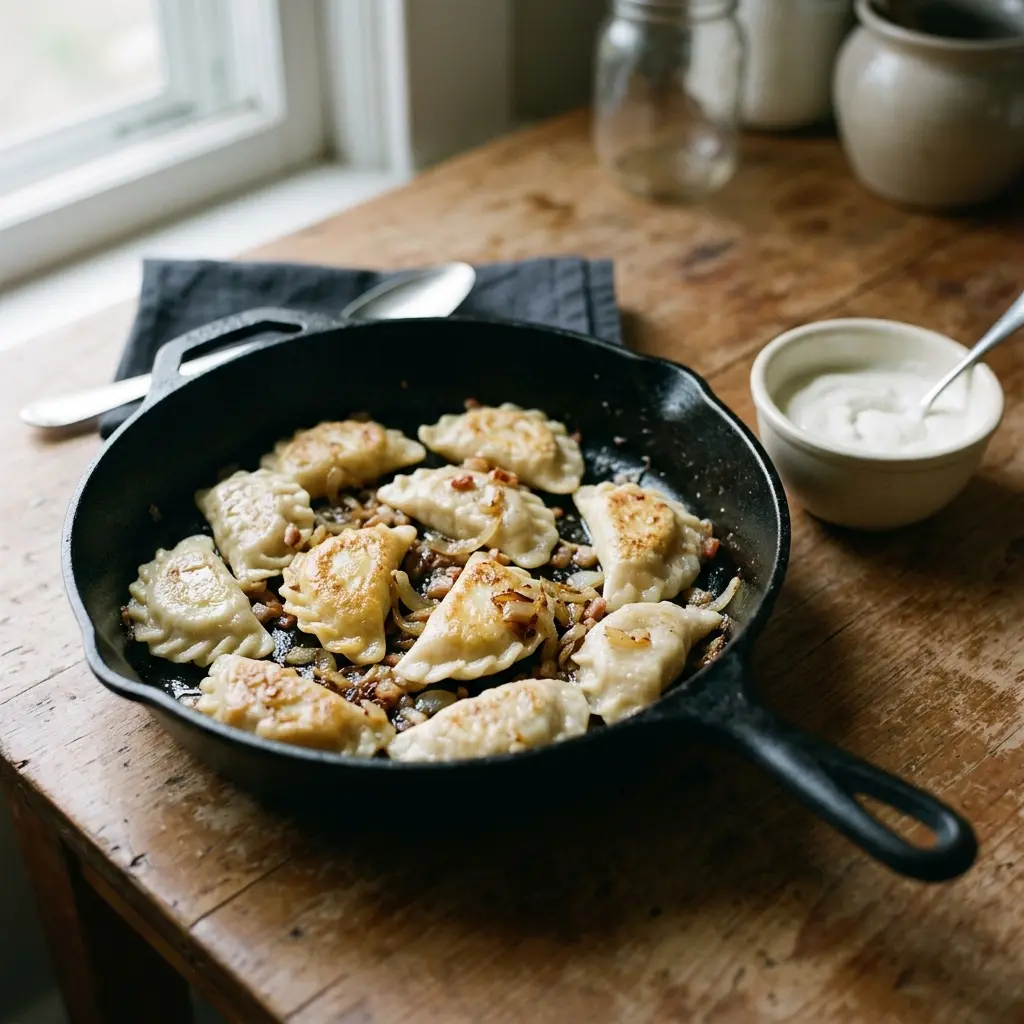
| 7. Fry them, if you like | For golden, crisp edges, fry the boiled and drained varenyky in butter over medium heat, turning once, with fried onion added at the end. | 2 to 3 minutes a side |
The recipe
Potato varenyky with fried onion
Classic Ukrainian dumplings of soft, thin dough filled with mashed potato and golden onion, boiled and served with butter and sour cream.
Ingredients
Dough
- 500 g (about 4 cups) all-purpose flour, plus more for rolling
- 250 ml (1 cup) warm water
- 1 large egg
- 2 tablespoons sunflower or vegetable oil
- 1 teaspoon salt
Filling
- 1 kg (2¼ lb) floury potatoes, such as russet or Yukon Gold
- 2 medium onions, finely diced
- 3 tablespoons butter
- 100 g (1 cup) grated aged cheddar or crumbled farmer’s cheese, optional, for potato and cheese varenyky
- Salt and freshly ground black pepper
To cook and serve
- 1 tablespoon salt for the cooking water
- 1 medium onion, sliced, and 2 tablespoons butter for frying
- 2 tablespoons melted butter
- Sour cream
Method
- 1
Boil the potatoes
Peel the potatoes, cut them into even chunks and boil them in salted water for about 20 minutes, until a knife slides through. Drain well.
- 2
Fry the onion
While the potatoes cook, fry the diced onions in the butter over medium-low heat for 12 to 15 minutes, stirring now and then, until soft and golden.
- 3
Make the filling
Mash the hot potatoes with the onion and its butter, and the cheese if using. Season well with salt and pepper, then leave the filling to cool completely.
- 4
Mix the dough
Whisk the flour and salt in a large bowl. Add the egg, warm water and oil, stir into a shaggy dough, then knead on the counter for 8 to 10 minutes until smooth and soft.
- 5
Rest the dough
Cover the dough with the upturned bowl or plastic wrap and let it rest for 30 minutes, so it rolls thin without springing back.
- 6
Roll it thin
Work with a quarter of the dough at a time and keep the rest covered. Roll it on a floured counter to about 2 mm (1/16 inch) thick.
- 7
Cut the circles
Cut circles 7 to 8 cm (3 inches) across with a glass or cutter. Gather the scraps into the next piece of dough.
- 8
Fill and pinch
Put a heaped teaspoon of filling in the middle of each circle, fold it into a half-moon and pinch the edges firmly together, pressing out any air. Crimp the edge if you like.
- 9
Hold or freeze
Set the varenyky on a floured tray under a clean towel. Any you will not cook today go into the freezer on the tray and into a bag once hard.
- 10
Boil in batches
Bring a large pot of water with 1 tablespoon of salt to a rolling boil. Add 15 to 20 varenyky, stir gently once, and boil 2 to 3 minutes after they float.
- 11
Butter them
Lift the varenyky out with a slotted spoon into a warm bowl and toss them with the melted butter. Repeat with the rest.
- 12
Serve
Fry the sliced onion in butter until golden, spoon it over the varenyky, and serve them hot with sour cream.
Tips
- Keep the filling cool and fairly dry. Warm, wet filling softens the dough and makes the edges hard to seal.
- Flour on the fingers makes the pinch hold; a damp fingertip helps if the dough has dried at the edge.
- Cook in batches. A crowded pot drops below the boil, and the dumplings stick and split.
- Frozen homemade varenyky cook exactly like bought ones: straight from the freezer, 2 to 3 minutes past the float.
How do you serve and store varenyky?
- Savoury varenyky: toss them in melted butter as they come out of the pot, spoon onion fried golden in butter over the top, and set a bowl of cold sour cream on the table. Crisp bits of fried salt pork or bacon are the traditional extra.
- Sweet varenyky: sour cream stirred with a spoon of sugar or honey, or the syrup from the cherries poured over.
- As a meal: six to eight varenyky make a main course for one; four go well after a bowl of borscht.
- To keep cooked varenyky: toss them in butter or oil so they stay separate, cover them and refrigerate within 2 hours. Eat them within 3 days.
- To reheat: fry them in butter over medium heat for 2 to 3 minutes a side until golden and hot through. A covered microwave dish with a splash of water works too, and leaves them soft.
- To freeze homemade varenyky: lay them apart on a floured tray and freeze until hard, about 1 to 2 hours, then bag them. They keep up to 3 months and go into the pot frozen.
- To drink: a cold glass of kvass or a light lager.
Common questions
How do you cook frozen varenyky?
Drop them still frozen into a large pot of salted water at a rolling boil, stir once so they do not stick, and boil them 2 to 3 minutes after they float to the top, about 6 to 8 minutes in all. Lift them out with a slotted spoon and toss them in melted butter.
Should you thaw frozen varenyky before boiling?
Cook them straight from the freezer. Thawed varenyky turn sticky, cling to each other and tear when they go into the pot, and the filling can leak into the water.
What is the difference between varenyky and pierogi?
They are close relatives. Varenyky is the Ukrainian name and pierogi the Polish one for boiled filled dumplings; Ukrainian varenyky tend to have thinner, softer dough and simple fillings such as potato, cheese, sauerkraut or cherries. In Canada, perogy usually names the same dumpling brought by Ukrainian settlers.
Can you pan-fry varenyky?
Yes, and it is the favourite way to eat leftovers. Boil them first, drain them well, then fry them in butter over medium heat for 2 to 3 minutes a side until golden in spots, and finish with fried onion and sour cream.
What do you eat with varenyky?
Savoury varenyky are served with melted butter, onion fried slowly until golden, and sour cream, often with crisp bits of fried salt pork on top. Sweet cherry or cheese varenyky get sour cream with sugar or honey. A bowl of borscht before them and a glass of kvass alongside make a full Ukrainian meal.
How long do varenyky keep in the freezer?
Up to 3 months in a sealed freezer bag. Freeze homemade ones on a floured tray first so they keep their shape, and cook them straight from frozen. Cooked varenyky keep 3 days in the fridge.
Sources
- Varenyky — Wikipedia
- Pierogi — Wikipedia
- Twelve-dish Christmas Eve supper — Wikipedia
- Christmas Eve (Gogol) — Wikipedia
- Varenyk Monument, Cherkasy — travels.in.ua
- World’s Largest Perogy, Glendon — Travel Alberta
- How to Cook Your Varenyky — BabaAid for Ukraine
- How to cook frozen varenyky — Ukrainian Flavors