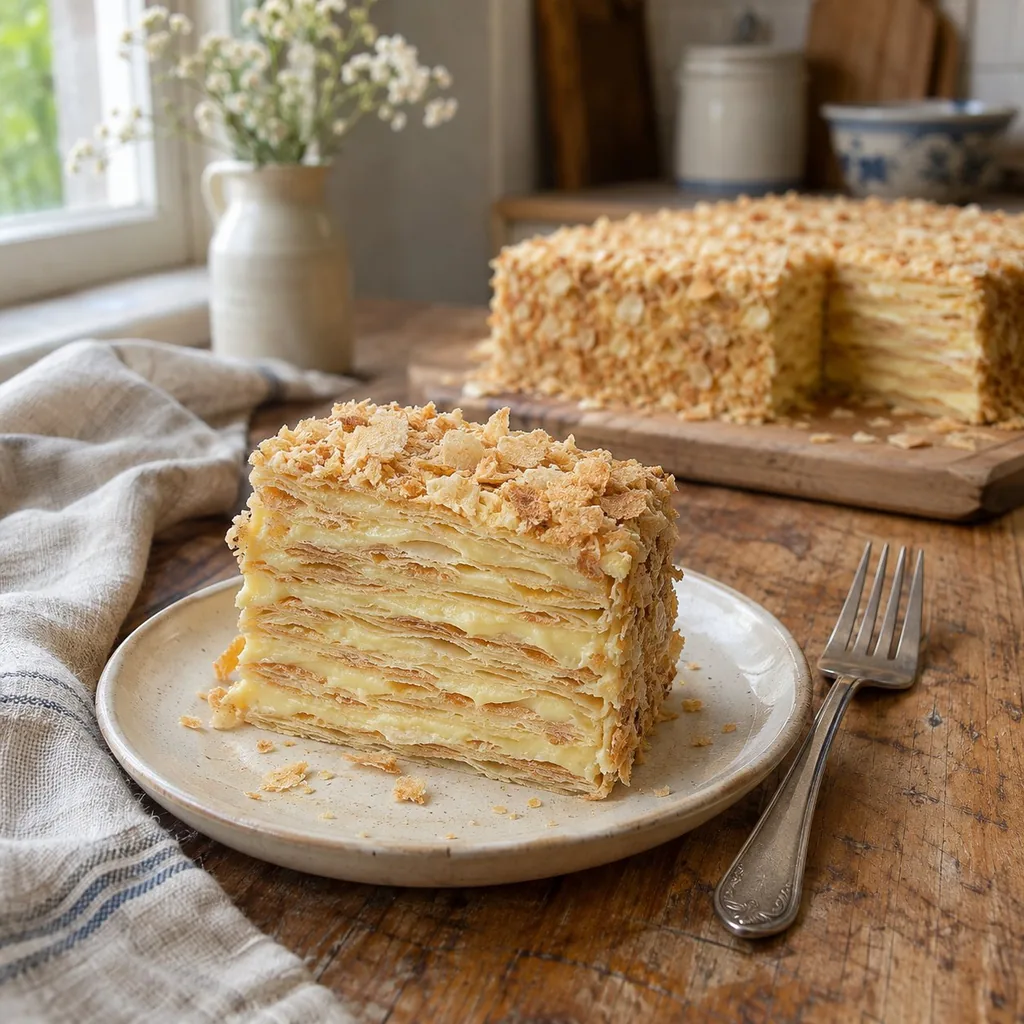
Napoleon is a tall cake of thin, crisp pastry layers stacked with vanilla custard and covered in crumbs made from the trimmings. It is the Eastern European cousin of the French mille-feuille, and in Ukrainian and Russian homes it shares the celebration-cake shelf with medovik.
Like medovik, it is made the day before. The layers bake crisp, and overnight the custard softens them until the cake cuts cleanly and melts on the tongue. This recipe uses a quick grated-butter dough that gives flaky layers without classic puff pastry folding.
The recipe
Napoleon cake with vanilla custard
A quick flaky dough rolled into eight thin rounds, baked crisp, stacked with vanilla custard enriched with butter and rested overnight.
Ingredients
Pastry layers
- 250 g (1 cup + 2 Tbsp) cold unsalted butter
- 420 g (3⅓ cups) all-purpose flour
- 1 large egg
- ½ cup (120 ml) ice-cold water
- 1 Tbsp white vinegar
- ¼ tsp salt
Custard
- 1 litre (4 cups) whole milk
- 4 large eggs
- 200 g (1 cup) sugar
- 60 g (½ cup) all-purpose flour or 50 g cornstarch
- 2 tsp vanilla extract
- 150 g (⅔ cup) unsalted butter, soft
Method
- 1
Grate the butter
Grate the cold butter into the flour on the coarse side of a box grater, tossing it in the flour as you go so the shreds stay separate.
- 2
Bring the dough together
Beat the egg with the water, vinegar and salt. Pour it into the flour and mix with a fork, then press into a ball with your hands. Small streaks of butter should still show.
- 3
Chill
Divide the dough into 8 equal pieces, about 95 g each, wrap and chill for at least 1 hour.
- 4
Make the custard
Heat 750 ml of the milk until steaming. Whisk the eggs, sugar, flour and the remaining cold milk smooth, pour in the hot milk while whisking, return to the pot and cook over medium heat, whisking, until thick and bubbling, 5 to 7 minutes. Add the vanilla, cover the surface with plastic wrap and cool completely.
- 5
Roll and bake the layers
Heat the oven to 200 °C (400 °F). Roll one piece of dough on parchment into a circle a little wider than 22 cm, as thin as you can, prick it all over and cut around a plate. Keep the trimmings. Bake 7 to 9 minutes until golden. Repeat with all eight, baking the trimmings too.
- 6
Finish the custard
Beat the soft butter until pale, then beat in the cooled custard a spoonful at a time until light and smooth.
- 7
Assemble
Spread about ½ cup of custard on the first layer and keep stacking, pressing each layer down gently. Cover the top and sides with the last of the custard.
- 8
Crumb and rest
Crush the baked trimmings into crumbs and press them over the top and sides. Cover and refrigerate for at least 8 hours, ideally overnight, before cutting.
Tips
- Keep the dough cold. Warm butter melts into the flour and the layers come out hard rather than flaky.
- Bake each layer on its own sheet of parchment; you can roll the next while one bakes.
- Napoleon keeps 4 days in the fridge and freezes, well wrapped, for 2 months.
Rather not cook?
We cook it, bring it to the office, or set the table for your event
Rather order a layered cake? OH! sells medovik, the Ukrainian honey cake, by the square in Ottawa.
Ask for a quoteor call +1 613 710-0554
Common questions
What is the difference between Napoleon cake and mille-feuille?
Both are pastry layers with cream. A French mille-feuille has three layers of puff pastry with pastry cream and an icing top and is eaten fresh. Napoleon cake has 8 or more thin layers, a buttery custard and a crumb coat, and rests overnight until soft.
How long does Napoleon cake need to rest?
At least 8 hours in the fridge, and overnight is best. Freshly assembled, the layers are still crisp and the cake crumbles when cut; the rest lets the custard soften them.
Can I use store-bought puff pastry?
Yes. Two 450 g packages of butter puff pastry make 8 thin layers. Roll each sheet thin, prick it well so it does not puff too high, and bake as above.