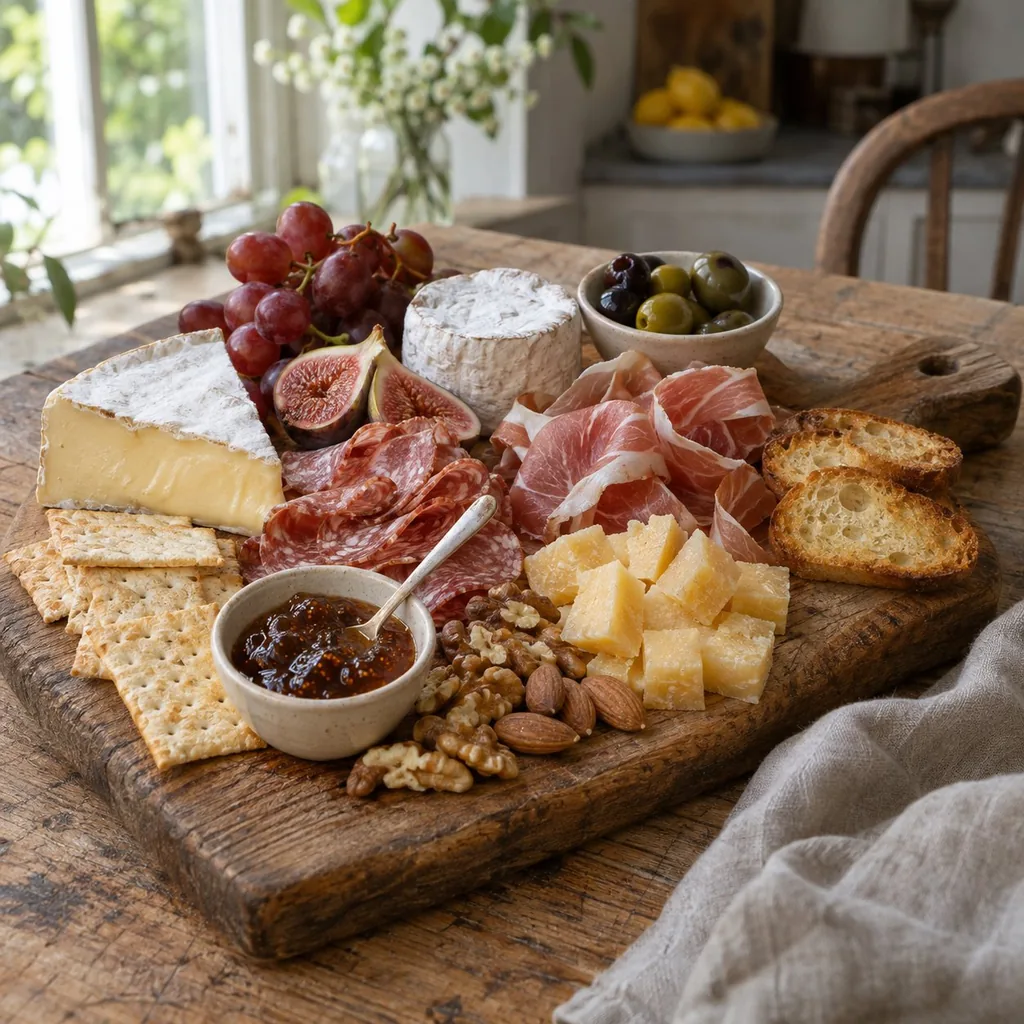
A charcuterie board is cured meat and cheese with the things eaten beside them, laid out on one surface so guests help themselves. The word comes from the French charcutier, the butcher who sells cooked and cured pork, and the board itself is a party habit from the last twenty years.
A good board is mostly arithmetic and order. Buy about 60 to 90 g of cheese and 50 to 60 g of meat per guest when the board is the appetizer, set the big pieces down first, and fill the gaps last. The recipe below is for eight guests and takes about 30 minutes to build.
The recipe
Charcuterie board for 8
Three cheeses, three cured meats, fruit, crunch and something sweet, built from the largest pieces to the smallest on one board.
Ingredients
Cheese
- 200 g (7 oz) aged cheddar or gouda, in a block
- 1 small wheel of brie or camembert, about 200 g (7 oz)
- 150 g (5 oz) blue cheese or manchego, in a wedge
Cured meat
- 120 g (4 oz) thinly sliced salami
- 100 g (3½ oz) prosciutto
- 100 g (3½ oz) coppa, soppressata or a second salami
Fruit and pickles
- 1 large bunch of grapes
- 4 fresh figs or 8 dried apricots
- 1 cup (150 g) mixed olives
- ½ cup cornichons
Crunch and sweet
- 2 boxes of crackers, two kinds
- 1 small baguette, sliced thin and toasted
- ½ cup (70 g) roasted almonds or walnuts
- 3 Tbsp fig jam or honey
- A few sprigs of rosemary to finish
Method
- 1
Take the cheese out early
Take the cheeses out of the fridge 30 to 45 minutes before guests arrive. Cold cheese tastes of very little; at room temperature the flavour comes back.
- 2
Set the bowls first
Place two or three small bowls on the board for the olives, the jam and the cornichons. Put them off-centre and apart; they anchor the layout and keep wet things off the crackers.
- 3
Place the cheeses
Set the three cheeses in a loose triangle, as far from each other as the board allows. Cut a few slices or wedges from each so guests can see how to start, and leave the rest whole.
- 4
Fold the meat
Fold the salami slices in half and in half again into quarters, and run them in a curving line, like a river, between two cheeses. Drape the prosciutto in loose ribbons; flat slices stick together.
- 5
Add the fruit
Lay the grapes in two or three small bunches near the cheese. Halve the figs and set them cut side up where the board needs colour.
- 6
Fan the crackers
Fan the crackers and toasts in short overlapping rows along the edges and beside each cheese, so every cheese has something to go on within reach.
- 7
Fill every gap
Fill the empty spaces with nuts and small things until no wood shows. A full board looks generous with the same amount of food.
- 8
Finish and serve
Tuck in the rosemary, add a knife for each cheese and small forks or picks for the olives, and serve within two hours.
Tips
- One soft, one firm and one bold cheese is the simplest mix that tastes like a choice.
- For a board that is the whole meal, double the meat and cheese and add a bread or a salad beside it.
- Cheese and cured meat keep their best at room temperature for about two hours; set out a second board later rather than one huge board at the start.
Rather not cook?
We cook it, bring it to the office, or set the table for your event
Hosting more people than one board can feed? OH! builds the same food on a whole table in Ottawa.
Ask for a quoteor call +1 613 710-0554
Common questions
How much charcuterie per person?
As an appetizer, plan about 50 to 60 g (2 oz) of cured meat and 60 to 90 g (2 to 3 oz) of cheese per guest. When the board is the meal, double both and add bread or a salad.
How far ahead can I make a charcuterie board?
Up to 4 hours ahead if you keep it covered in the fridge and leave the crackers and bread off until just before serving, so they stay crisp. Take it out 30 minutes before guests arrive.
What is the difference between a charcuterie board and a grazing table?
Size and setup. A board is one platter for roughly six to twelve people, carried in whole. A grazing table covers a whole table with the same categories of food and feeds twenty and more.