
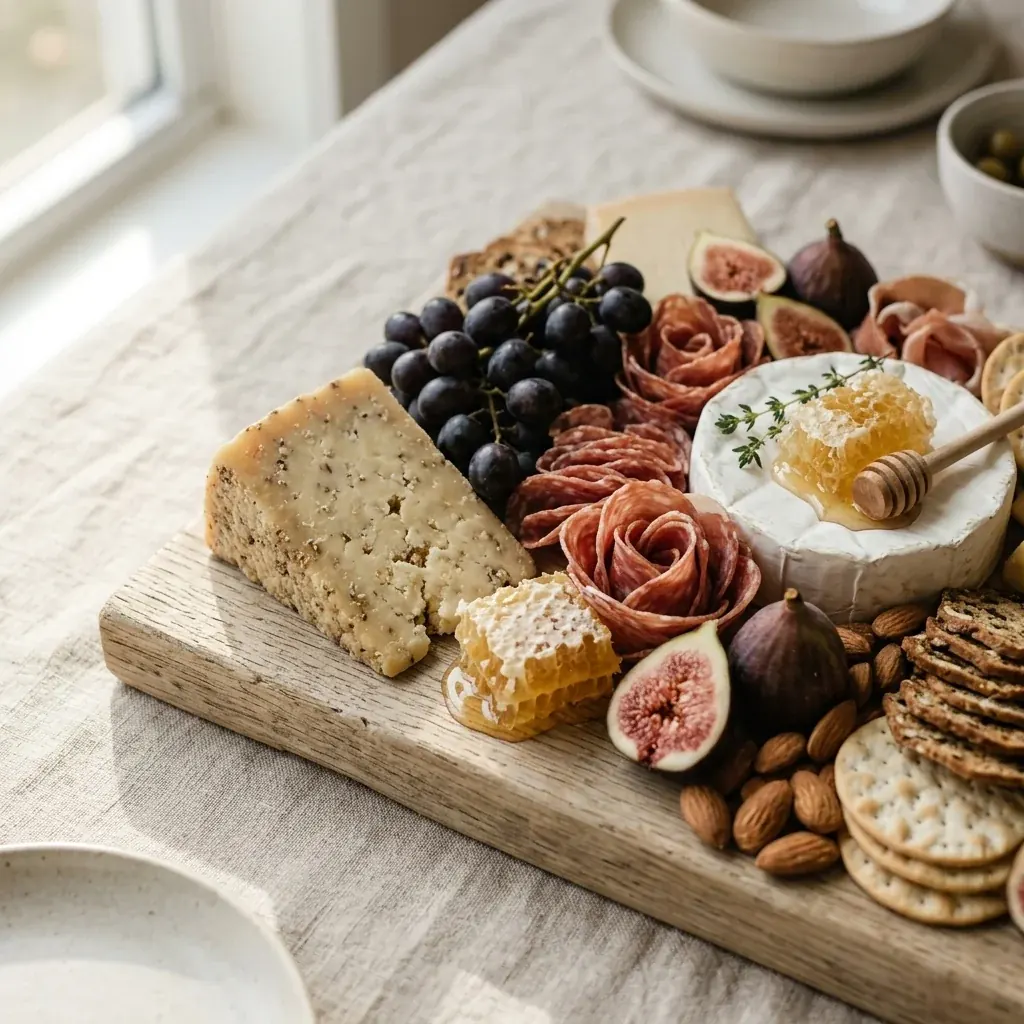
A grazing table is a composition with six jobs to cover, and the fastest way to build a poor one is to buy more of what you already have. Rich, fresh, salty, crunchy, substantial and sweet. Hold all six and the table survives any seasonal ingredient swap; drop one and guests feel it without being able to name it.
Rich carries the table: three to five cheeses across textures — one soft, one hard, one blue or washed if your guests will eat it — plus two or three cured meats. Around 60 to 90 g of cheese per guest is the working figure when the table also holds substantial savoury items, rising towards 120 g when cheese is doing most of the work.
Fresh does the visual work and the palate reset: whole and cut seasonal fruit, crudités, herbs used as structure. This is the category where an Ottawa table changes completely through the year. In January it means citrus, pomegranate, pears and forced rhubarb. In late June it means Ontario strawberries, then blueberries and stone fruit through August, alongside field tomatoes when the Parkdale and ByWard stalls have them. In October it means Ontario apples, grapes and squash. Same budget, entirely different surface.
Salty and crunchy are the two categories most often under-bought. Olives, cornichons, marinated peppers and pickled vegetables cut an hour of cheese. Crackers, crostini and nuts give the table its structure — plan roughly six to eight crackers or crostini per guest, because they disappear faster than anything else on the surface.
Substantial decides whether your table is an appetiser or the meal. Tartlets, mini sandwiches, arancini, skewers, a hot item where the space allows one. As an appetiser, two to three substantial pieces per guest. As the meal, five to seven — and that single decision moves the quote further than any ingredient choice on the table.
Sweet closes it: small pastries, chocolate, fruit that reads as dessert. Two to three pieces per guest is plenty, because by that point in an event most people are drinking and talking.
Scaling to a guest count is arithmetic on two separate measurements. The first is capacity, what the surface feeds across the whole event. A 1.8 m trestle — the standard six-foot folding table — carries a grazing display for roughly twenty to twenty-five guests at appetiser level, a 2.4 m surface takes thirty to forty, and fifty guests want two 1.8 m tables joined or run as a pair. The second is access, what the queue needs at any one moment. Allow about 30 cm of open table edge for every guest standing at it in the same moment, which is why a table pushed against a wall queues twice as long as one you can walk around. Depth of 75 to 90 cm gives the layering somewhere to go on a table guests can reach from both long sides. Against a wall, keep it under about 70 cm, because the back row of a one-sided table goes untouched. Item count rises with the surface: 14 to 16 distinct items on a 1.8 m table, 22 to 24 on 2.4 m, 26 to 30 across 3.6 m or two tables joined, with a second wave held back, because a fifty-guest table laid out all at once is picked over within half an hour.
Layout does as much work as the shopping list. Build the table from the middle out, put the two or three items you want people to notice at eye level on risers, and split the crackers into two or three points along the length so a thirty-guest table has more than one place to stand. Keep the substantial items closest to where guests enter, because that is the part of the surface that empties first and the part they will judge the table by.
Label everything, and label it early. A small card in front of each item saves guests from asking, keeps the vegetarian items from disappearing into a plate of cured meat, and turns the dietary conversation into something concrete. The wording we use is the same on every page of this site: Share dietary preferences and allergy information when you enquire. We plan suitable choices and label the table clearly. For severe or life-threatening allergies we talk through cross-contact before you book, and we cannot guarantee allergen-free preparation on a shared table.
Two structural rules regardless of size. Group colour in blocks so the surface reads as composed from across the room. And build height with risers, boxes or upturned bowls under the linen — a flat table of the same food looks like half the quantity.
One timing rule that overrides all of the above: a table holding dairy and cured meat comes down after about two hours at room temperature, and after about one hour once the space is warmer than about 32 °C. On an Ottawa patio in July that shortens the plan; in a heated room in February it does not. Below freezing, an outdoor table stops working altogether — soft cheese goes waxy, cut fruit weeps and then freezes, and pastry hardens within fifteen minutes.
Scaling a grazing table that replaces a meal
| Guests | Table length | Distinct items | Cheese | Crackers and crostini | Substantial pieces |
|---|---|---|---|---|---|
| 12 | 1.8 m | 14–16 | 0.7–1.1 kg | about 85 | 60–85 |
| 20 | 1.8–2.4 m | 18–20 | 1.2–1.8 kg | about 140 | 100–140 |
| 30 | 2.4 m | 22–24 | 1.8–2.7 kg | about 210 | 150–210 |
| 50 | 3.6 m or two joined | 26–30 | 3–4.5 kg | about 350 | 250–350 |
The fresh category through an Ottawa year
| Season | What is at its best | What it does for the table |
|---|---|---|
| January to March | Citrus, pomegranate, pears, forced rhubarb | Colour and acidity when nothing local is growing |
| April to June | Ontario asparagus, radishes, early greens, rhubarb, first strawberries | Green structure and the first fruit of the year |
| July to September | Berries, stone fruit, field tomatoes, corn, cucumbers | The cheapest abundance of the year, and the shortest hold time |
| October to December | Ontario apples, grapes, squash, cranberries, pears | Deeper colour that suits the indoor season and holiday tables |
Common questions
How long should a grazing table be for 30 guests?
About 2.4 m, the surface that carries thirty to forty guests, with 22 to 24 distinct items on it. Depth of 75 to 90 cm gives the layering somewhere to go on a table guests can reach from both long sides. Against a wall, keep it under about 70 cm, because the back row of a one-sided table goes untouched. Build height with risers under the linen, and allow about 30 cm of open edge for each guest standing at it in the same moment, so the queue moves.
What are the six categories on a grazing table?
Rich (cheese and cured meat), fresh (seasonal fruit, crudités, herbs), salty (olives, pickles, marinated vegetables), crunchy (crackers, crostini, nuts), substantial (tartlets, sandwiches, skewers) and sweet (pastries, chocolate). All six present is what makes the table feel complete.
How long can a grazing table sit out?
A table holding dairy and cured meat comes down after about two hours at room temperature, and after about one hour once the space is warmer than about 32 °C. Plan the event around that window, and hold the second wave in the fridge until it is needed.
What Goes on a Grazing Table — the short version
- Six categories: rich, fresh, salty, crunchy, substantial, sweet.
- Cheese: 60–90 g per guest with savoury items present, up to 120 g without.
- Crackers and crostini: 6–8 per guest — the most under-bought item.
- Substantial: 2–3 pieces per guest as an appetiser, 5–7 as the meal.
- 12 guests: 1.8 m and 14–16 items. 30: 2.4 m and 22–24. 50: 3.6 m and 26–30.
- About 30 cm of open edge per guest standing at the table; 75–90 cm deep where both sides are reachable, under 70 cm against a wall.
- At 50 guests, hold a second wave back and release it after the first half hour.
- About two hours at room temperature is the working limit, and about one hour above about 32 °C.
Planning this kind of event in Ottawa? Read how OH! handles Holiday Grazing Table in Ottawa, or browse the service areas we cover.
Planning something in Ottawa?
Tell us the date, guest count and the feeling you want. We’ll help shape the table around it.
Plan your table